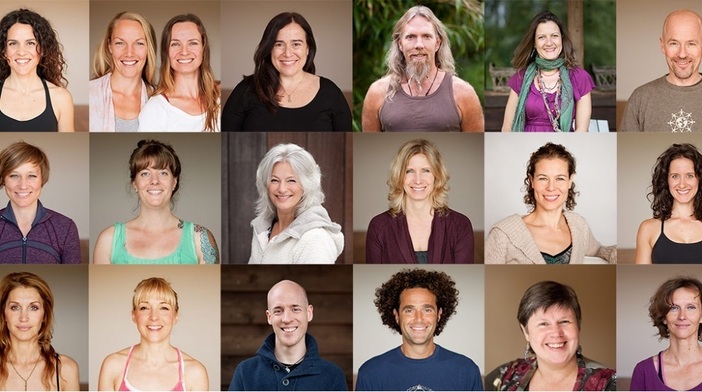
Teachers thoughts: which yoga pose has taught you the most?
Jennilee Toner - Virabhadrasana II - Warrior 2
Focusing on my dreams and goals
For many years the pose that I resisted staying in for a long time was Virabhadrasana II (Warrior 2). I have always loved Warrior 1 (I am a self-proclaimed internal rotator and not so much an external rotator!) but when it came to the longer-held Warrior 2 posture, I found myself frustrated, angry and a bit rebellious, coming in and out of the pose as I saw fit.
Over time though, I began teaching themed classes with the energy of Warrior 1 being "I AM HERE" and the energy of Warrior Two Pose being "I AM TAKING AIM AT MY GOALS, DREAMS AND VISIONS." And low and behold, what I was teaching became my own mantra and voila! - I am now in love with the longer-held Warrior 2 pose! I hold still and scan my body, finding both the strength (Sthira) and sweetness (Sukha) in my body and mind. I stare out just beyond my middle finger, breathing and focusing on my goals, dreams and visions...seeing myself attaining them!
- EkhartYoga members can practise Jennilee's Hot Warrior Yoga classes.
MacKenzie Miller - Hanumanasana - Splits pose
Taking it a day at a time
There's no doubt in my mind that the pose that's taught me the most is Hanumanasana. I have found that strength poses like handstand can be obtained by willpower and determination, but flexibility poses like Hanumanasana cannot be forced.
In fact, if anything you have to be willing to surrender, be patient, kind and loving to your body. Anatomically the splits are incredibly difficult because they require not only flexible hamstrings but flexible hip flexors too. The anxiety I've felt while breathing through Hanumanasana has challenged the steadiness of my mind. The intensity of sensation I've felt physically has challenged my will to stay with the pose and watch as the sensations soften if I allow them too. A decade into my physical practice I am shocked at how the posture has evolved in my body. I love and have made peace with Hanumanasana, I take it one day at a time, and appreciate the many lessons it has taught me.
- EkhartYoga members can practise Hanumanasana with MacKenzie in her class,Post Travel: refreshed and renewed
James Reeves - Savasana - Corpse pose
How to 'be'
In my first ever yoga class, when asked to lay down and be still, it felt like torture. All the energy that had been awoken during the movement and postures manifested as restlessness. I felt incredibly irritable, full of dislike for the environment and the teacher, "how dare they make me stay here when I’m so uncomfortable!” and I had this weird feeling of discomfort behind my eyes.
I kept touching my forehead and the teacher came over and politely asked me to ‘lay still’. What happened, as a result of staying with that discomfort, transformed into a deep experience of interconnectedness. Had I been able to leave, I’d have probably eaten some food, gone for a walk or vented my frustration on some other poor soul in the ashram, but as it was, I had to stay with it. The staying allowed the sensation at my forehead to gather in intensity and I now know that this was insight developing, and the beginnings of a ‘witness’ state that went on for quite some time. In fact, it took me a few hours to even feel like I was in my body, and I spent the rest of the day floating around in my first experience of ‘yoga bliss’.
Since then, Savasana has kept on teaching me; how to be with my uncomfortable feelings, how to rest and not do anything, how to ‘be’. This is why I specialise in teaching this pose and in Yoga Nidra. Who’d have thought laying around on the floor could be so challenging?!
- EkhartYoga members can practise James' Yoga Nidra program: Yoga Nidra: Effortless Awakening
Adela Serrano - inversions
Daring to trust
I still vividly remember the fear I used to feel when the teacher would say that we were "moving our mats to the wall for inversions". That phrase would paralyse me with fear and I would look for a million excuses not to do them.
I still haven't figured out the root of that fear. I just kept practising yoga and one day (I wasn't having a particularly goodday, I just wanted to do yoga and not really think about anything) I went to class and when my teacher announced we were doing inversions, I didn't think twice. I turned around, put my hands on the floor and up I went!
The teacher helped me to come up and then I found myself in Handstand! After all those years dragging out the inversions moment, of course, it was the day when I wasn't really thinking about it that I finally made it upside down.
I guess the lesson here was about trust: trust that your body can do more than you probably think. It has taught me to not overthink things a million times, to dare to take the leap and trust the part of you that knows. Inversions are now my favourite part of the practice!
- EkhartYoga members can practise inversions with Adela: Fundamentals of yoga: inversions - Hatha / Vinyasa flow, 45 mins, all levels
David Lurey - Simhasana (in the Iyengar style)
Stress reliever
This posture is essentially Lotus pose, but with the legs underneath instead of above. I learned it from Eddie Modestini around 2003 and it opened my hips (and my threshold for pain/sensation) in many ways. The crossing point at the inner shin is an acupressure point and the subtle manipulation of the femur bone in the hip joint has the potential to make Lotus pose accessible when it is muscle tension rather than bone compression that holds you back. In addition to the ankle, knee and hip benefits, the part of the pose with the exhale and the tongue is a perfect stress reliever!
- EkhartYoga members can practise this pose in David's Garden of Delight class - Hatha, all levels, 45 mins
Véronique Gauthier - Hanumanasana - Splits pose
Patience and no expectations
Although many poses have taught me a lot, the first to come to my mind is Hanumanasana (Splits pose), the Monkey God pose. The first lesson it taught me was to be patient. I only attempted Hanumanasana after several years of yoga practice and even now, I only do it after a very careful preparation. The second lesson was that the mind, and not only the body, needs to be ready. For a long time, I was afraid to hurt myself and was always “stuck” a few inches off the mat. It’s only once I let go of my fear that I could move into the full pose and enjoy its many benefits. I was really happy and it felt great. However, Hanumanasana also taught me a third lesson: not to take anything for granted. One day, this pose will feel fantastic, empowering, uplifting. The next day, it might be the opposite. But the most important thing is to keep getting on the mat, with a smile and without expectations.
Anat Geiger - Sukhasana - Easy pose
Let go, examine, understand, illuminate and transcend
My first instinct was to say “any pose on my hands”, as all hand balancing poses were and continue to be hard work for me because of my physical build. And although that is very true, there is one more pose that teaches me the most: Sukhasana, Easy pose. It’s the one pose I do every day when I meditate. I have done this pose when brokenhearted, exhausted, scared, desperate, exhilarated, grateful, sleepy, bursting with love.
I have done this pose when brokenhearted, exhausted, scared, desperate, exhilarated, grateful, sleepy, bursting with love.
The most simple and most difficult of poses to stay in it whatever happens, to let go, examine, understand, illuminate and transcend. The one pose where I learn something every day and the one I cannot live without.
- EkhartYoga members can practise two different meditation techniques with Anat in Meet your Svadhisthana chakra - Hatha/Meditation, all levels, 45 mins
Sandra Carson- Adho Mukha Vrksasana - Handstand
Stepping back from judgment
For years I have been practising this pose and have not been able to master it, freestanding in the middle of the room. The very first time I tried Handstand in a yoga class, I was totally unprepared and fell on my head. That may have gotten me off on the wrong foot with this pose! But I love to practise it and have learned to manage wall-free standing, but I still need the security of a wall behind me.
I have and still am learning from practising this pose. Often when I don’t feel strong and steady in my core, my Handstands will feel like jelly and all floppy. When I have patience and am well prepared, the pose seems almost effortless sometimes. But mostly I have learned (and am still learning) that it is more about what feelings, thoughts and expectations come up when I practise. Some judgments I had about myself 15 years ago are still popping up when I try Handstand. More and more, I am learning to see these and to view them as old (but not such dear!) friends coming to visit!
- EkhartYoga members can practise Handstands with Sandra in her class, Grow: air - Vinyasa flow / Anusara, level 1/2, 60 mins
Andrew Wrenn - Padmasana - Lotus pose
The merging of breath, mind and emotions
This is an easy one for me, sitting! My preference these days is for Padmasana, though any comfortable seated position with the spine comfortably upright will do, even sitting in a hard-backed chair. With my physical body comfortably supported I can open to the delightful experience of simply being. My mind merging with the breath, thoughts arising and passing, emotions changing whilst experiencing the clarity and peace of the unfolding universe in the present moment!
- EkhartYoga members can learn how to sit for meditation with Andrew in his Beginners' guide class - Meditation, all levels, 20 mins
Francesca Giusti- Sirsasana - Headstand
Beautiful equilibrium
It's hard to limit to a posture only, but on the physical and emotional level, I would probably say Headstand - Sirsasana. I have had a respectful love/hate relationship with this posture since I began to practise yoga, and being part of the primary series in Ashtanga yoga (which was my self-practice "footprint" for many years) I was required to learn it and practise it very early on in my yoga journey. It's taken many years and many different approaches and styles so make me appreciate fully the challenging and transformative nature of being upside down. A beautiful equilibrium between fear, exhilaration, empowerment and body awareness.
I'm still learning it as every day is a different day and every day body/mind/soul connection inspires a different quality to inversions. There are many more amazing postures, very simple ones that have taught me to slow down and really take time to be with myself, something I have to practise every day...
- EkhartYoga members can learn Headstand in Francesca's class, Building up to Headstand - Hatha, level 1, 45 mins
Esther Ekhart - Savasana - Corpse pose
Getting in touch with how I am
This pose tells me about myself. Savasana is the pose that gives me always honest feedback. When the body is relaxed and open, the mat feels soft and it feels like I’m sinking away in the earth. When the body is tight, I fidget and find it hard to relax.
When the mind is relaxed, I am the space for the breath, the occasional thought and all the sensations rising and dissolving. When the mind races, I am identified with the thoughts and I find it hard to focus on the space in which they happen. Basically, in Savasana I get in touch with the deeper mind and its movements, and from there I find ways to work with what I have learned in Savasana about myself. I sometimes start my practice with Savasana to really have an honest 'look' at what state I'm in, adapting my practice to suit this. At the end of my practice, Savasana helps me to absorb what the practice has brought me and to understand what I take with me when I step back into my day.
- EkhartYoga members can join Esther in this deeply relaxing Body Scan
José de Groot - Saddle pose
Letting go
For me, Saddle pose continues to teach me a lot. On an emotional level, it encourages me to let go and surrender to whatever arises. This is intimately linked to the physical level as I experience an intense opening sensation in my hip flexors, quads and also my belly area, particularly in the intestines.
If I want to stretch the front of my body, I have to let go and allow the compression go into my back by relaxing my back muscles, rather than activating them to avoid compression. This physical 'act' always has the emotional effect on me of complete surrender. At times this is harder to do than others. So if I want to practise letting go and surrendering, I go for Saddle pose.
- EkhartYoga members can practise Saddle pose with José in her Stretching before or after running routine
Over to you!
We'd love to know which yoga pose has taught you the most important lesson. Please share in the comments section below.


Kirsty is from the UK and moved to the Netherlands to work for EkhartYoga (now YogaEasy) in 2015. She's an E-RYT 500hr trained yoga teacher and has completed many courses in meditation, anatomy, mindfulness and Yoga Nidra. Kirsty previously worked in publishing, graphic design and recruitment. Her role as Content Lead at YogaEasy includes content writing, program creation, and teacher relations. She is currently studying for a Masters in Creative Writing for Therapeutic Purposes.