
Yoga for strength
Over the past few years, there has been a boom in strength training in its various forms, from CrossFit and weightlifting to more outdoor, functional Movement-based training. If you can put on your protective social media blinkers and look beyond the many, MANY, workout selfies, there’s a whole culture of people getting out, moving more, encouraging each other and generally feeling better about themselves.
So why is building strength important?
- It improves bone density, reducing our risk of osteoporosis.
- We naturally lose lean muscle mass as part of the ageing process. Strength training can help to preserve it.
- Stronger muscles help to stabilise the joints. This can help to prevent injuries - especially important for those with hypermobile joints.
- Strength training helps to improve your RMR (resting metabolic rate).
- It has also been shown to have a positive effect on our mental health, including reductions in anxiety, depression, and pain intensity; improved sleep and confidence, self-esteem, and resilience.
Does yoga count as strength training?
The short answer is ... it depends. There are so many different ways to practise that it’s not possible just to prescribe only ‘yoga’ to get stronger. Certain types of yoga like Yin and Restorative will not help you build muscle and nor should they, but with asanas such as Warrior poses, Planks, arm balances and inversions, we are in effect “weight training” as we support our own body weight in gravity.
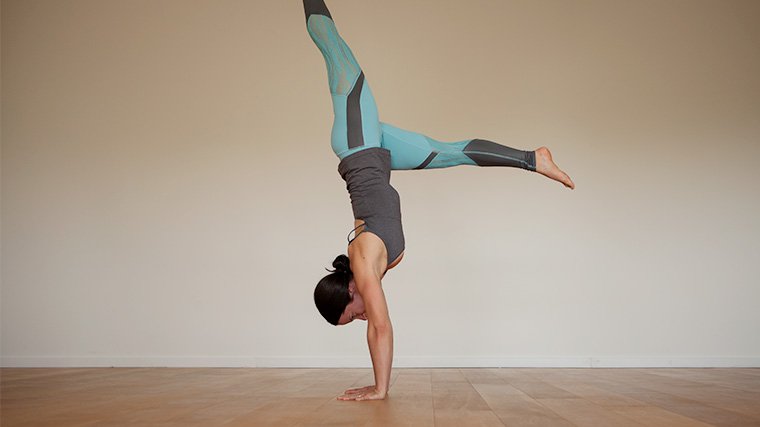
When we practise yoga poses we involve the whole body, rather than trying to isolate specific muscles - like when using fixed gym machines. We recruit other muscle groups to act as stabilisers, as well as the muscles where the main action takes places.
For example, in Chaturanga Dandasana although we might feel it most in the upper body, the abs, back, inner thighs and even muscles in the feet are also working. We can really feel this in arm balances and inversions where smaller muscles are working hard to keep us stable.
In this way, yoga can be a great form of functional strength training. Meaning building strength in the whole body so that it can perform daily activities in the real world, not just lifting a certain amount of weight.
Yoga can be a great form of functional strength training - building strength in the whole body so that it can perform daily activities in the real world.
How can I get stronger with yoga?
There are different ways we can build strength through yoga and it's good to use a mix of techniques for balance.
Repetition
Dynamic styles of yoga such as Ashtanga and Vinyasa build strength through repeated Sun Salutations and Vinyasas. These are particularly good for building strength in the upper body and legs. Repeated Sun Salutations don’t suit everybody though so it’s important to know how to modify them and also to mix them up with different strength-focused classes like we do in our Empowered Yoga Challenge.
These styles of yoga were likely influenced by European bodybuilding and gymnastics (see Mark Singleton’s Yoga Body book for more on that).
As the body starts to get used to the practice, you can increase the challenge - this could be by adding in extra Core Planks, progressing to different kinds of arm balances or moving dynamically through asanas.
You can also include explosive actions into your practice like jumping from Downward Facing Dog to the front of the mat, or Handstand hops as in Jeff Phenix's class: Strong, short flow 30 minutes, Vinyasa Flow, Level 1, 2 (for YogaEasy members)
Holding yoga poses for longer
Increasing the length of time we hold poses is one of the most simple ways of building up strength quickly without equipment and allows us to see how we are progressing. These are examples of isometric exercises, also known as static strength training.
Try staying in poses for up to a minute or two, or up to 10 deep breaths for hand balances like Crow and Handstand. Always come out of the pose (carefully) if you feel you losing good form and alignment or if you are sacrificing the quality of your breath.
Try poses like:
Plank
Dolphin
Downward Facing Dog
Tree
Warrior Poses
Chair Pose
Boat Pose
- EkhartYoga members can try this in class with Esther Ekhart in Burn Baby Burn and Peaceful energy with 1 minute holds.
But is yoga enough?
So can we get the benefits of strength training through yoga alone? The first thing is to look at our motivation and goals around getting stronger. As we said earlier, yoga is a form of functional strength training so it helps us to build enough strength for our day to day activities - and more depending on how we practise.
If you want to dramatically increase muscle mass, however, you’ll need to add in extra weights and resistance and train specifically for that. But adding extra weights into your practice can be beneficial even if your goal is not to get bigger muscles.
Variety
There is a growing body of yoga teachers and practitioners who are recognising the value of cross-training by adding weights or kettle-bell workouts to their week. Or using resistance bands or pull-ups against gravity to include more ‘pulling actions’ for the body (yoga tends to be more about pushing actions).
Using free weights or extra resistance can also be therapeutic to correct muscle imbalances.
You can also add weights to your yoga practice holding small hand weights (or water bottles, tins of food etc) during Warrior poses. This can be a really good way of working on your arm and upper body strength if you have wrist problems and are avoiding Downward Dogs and Planks.
Jennilee Toner has a whole playlist of Yoga with Weights classes where you can try this out.
Join our 3-week Empowered Yoga Challenge!
Give yourself permission to be powerful!
Join our 3-week challenge with daily 30-minute classes for intermediate to advanced students who want to develop strength and stamina, and access inner confidence.
Related:
- Read how YogaEasy teachers work on building strength in Teachers Thoughts.
- Holding a pose also brings other benefits as Esther explains in 4 Benefits of Holding a Pose
- What about cardio? Yoga and cardiac health




Jenny Savage was part of the behind the scenes EkhartYoga team. She first started yoga at the age of 15 and took her 200hr teacher training with Esther Ekhart in 2013. She has a background in Health Psychology, community mental health work, and health and wellbeing research.


