Is your asana practice supporting your meditation practice?
In a meditation session I recently taught I was surprised to notice that more than half the participants were either leaning against the wall or against a back jack (floor chair). Understandably, there are usually one or two people in a group who will use the wall to support themselves due to chronic back/hip injuries or vulnerabilities, but never before have I witnessed a session where more than half the room was in need of the wall!
I noticed my reaction with interest - and that’s why I wrote this piece. Instead of just firmly instructing everyone to sit without the wall, I was moved to compassionately inquire...why did so many of them need the wall or the floor chair? Wasn’t their asana practice supporting their seated meditation practice?
Yoga citta vrtti nirodhah - yoga is the ceasing of the fluctuations of the mind
Today, in much of the modern world, 'yoga' is considered to be a 60-90 minute community class where an instructor teaches participants physical yoga postures, often linked with breath. These classes as we know can be of various different natures and themes: hot, sweaty, athletic, dynamic, fun, easy, sweet, boring, lots of movement, no movement, loud music, no music, super strict, super gentle and loving, or all of the above (and so much more).
We “do” yoga in studios, in gyms, in parks, in the air on swings and slacklines, in the water on paddleboards, with hand weights, with exercise balls, with goats, with cats, with gloves and socks on or off, and with yoga clothes on...or off! In the modern day era of yoga we have created so many fun and interesting ways to practice yoga. Practice our yoga postures (asanas) that is! But, as many of us discover, 'yoga' is much more than these physical yoga postures.
In the Yoga Sutras, Sage Patanjali outlines yoga as “the ceasing of the fluctuations of the mind”. In order to do this Patanjali outlines a detailed step-by-step process (the eight limbs of yoga). His eight limbs of yoga consist of yamas, niyamas, asana, pranayama, pratyahara, dharana, dhyana and samadhi.
The first four limbs of yoga are the foundation for the last four limbs of yoga
The five Yamas and five Niyamas are our moral disciplines and observances (such as non-violence, truthfulness, greedlessness, purity, contentment and right effort). Asana is our body’s posture (seat) and Pranayama is the control (retention) of pranic energy, via the breath. These first four limbs (or one could consider them steps) create and sustain the foundation for the latter four limbs of sense withdrawal, concentration, meditation and absorption (pratyhara, dharana, dhyana and samadhi).
Therefore the question we need to ask ourselves is: Are our asana and pranayama practices (at home or in the community classes) instilling in us the physical and mental strength and fortitude needed if we are to engage in the hard work and discipline our meditation practice requires of us? Or put another way, are our asana and pranayama practices preparing us and supporting us in the way they ought to if we are to progress on the yogic path?
Asana: your seat
Asana is a Sanskrit word meaning “to sit” or “to sit down.” In the Yoga Sutras the word “asana” is only mentioned once: “posture should be steady and comfortable” (2.46 sthira sukkham asanam), and referred to three times “such posture shall be attained by the relaxation of effort and by absorption of the infinite” (2.47 prayatna saithilyananta samapattibhyam), “from this (mastering posture), one is not afflicted by the dualities of opposites” (2.48 tato dvandvanabhighatah) and “when that (asana) is attained, pranayamah, breath control, follows...this consists of the regulation of the incoming and outgoing breaths” (2.49 tasmin sati svasa prasvasayor gati-vicchedah pranayamah).
As Edwin F. Bryant states in his translation and commentary of the Yoga Sutras:
“Patanjali has relatively little to say about asana, leaving us with only three sutras on the topic, consisting of a total of eight words, or, put differently, considerably less than one percent of the text occupies itself with asana.”
Steady (Sthira) and Comfortable (Sukha) Asana
Even if Patanjali only offered us eight words to describe asana, the words he used are incredibly deep and weighty in both their meaning and implications. He essentially stated that our meditation posture should be steady (sthira) and comfortable (sukha). Modern day translation is that each and every posture we create and maintain on AND off the mat should be steady and comfortable. What we do on the mat is a direct reflection of what we do off the mat; how we do anything is how we do everything. I teach often that the posturing we do in life, in our relationships (family, business, community, etc), should be as steady and comfortable as our yoga asanas.
What helps us be more steady and comfortable in our postures both on and off the mat? We yogis know this answer - THE BREATH! Becoming intimate with our life force energy via the breath is such a magnificent support practice for being “steady and comfortable". Our breath will tell us when we are not (rapid, inconsistent, or strained) and when we are (slow, steady, and even). Asana and basic Pranayama techniques are necessary foundational tools for us to progress further on the yoga path - the path of the ceasing of the fluctuations of the mind.
Why is sitting so difficult?
As my example from earlier illustrates, often new meditators find they need to use a wall or floor chair to prop themselves against for their seated meditation practice. Why do many of us find sitting for long periods of time unsupported so hard? There are two key physical aspects: the spine for sitting upright and the hips for sitting comfortably.
The spine
The 31-33 bones of your spine are the axis of your being. This is your “core” especially when you adapt the “Apple Core Theory” which is the center line from top to bottom. Your spine has these amazing natural convex and concave curves and there are specific muscles that support the spine in its axial extension (to stay upright) as well as move the spine in flexion and extension (forward bends, backbends), lateral flexion (side bends) and rotation (twists). Unfortunately, the convex curve of the upper back has become exaggerated for many of us who spend most of our waking time in the forward flexion portion of the sagittal plane (sitting at a desk, driving a car, riding a bike, watching TV. etc). This has a knock on effect of bringing our head forward. As a result it can be very hard and tiring for many of us to sit up straight and meditate for long periods of time unsupported. Our muscles supporting the spine have to put in extra work to bring us into what should be our natural and neutral upright position.
The hips
Another factor to consider for our meditation posture is our individual differences when it comes to hips and knees: specifically to what degree they are able to internally rotate or externally rotate. These individual differences are down to both differences in the shape and position of our bones and also the degree of flexibility of our soft tissues (muscles, ligaments and fascia). This range of motion combined with the seated posture we adopt will affect our steadiness, comfort and ease when we sit and meditate.
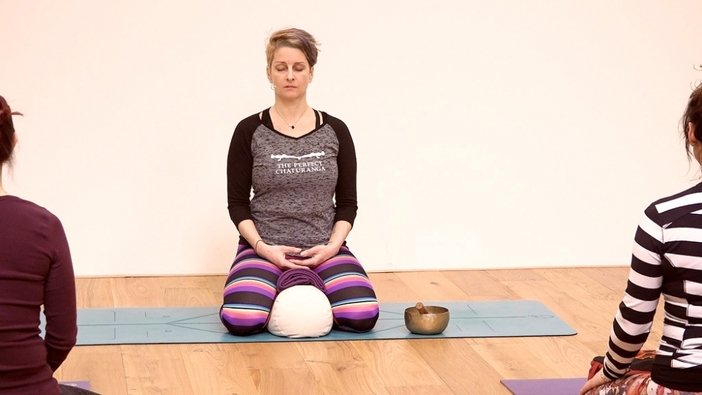
For example, my hip sockets are set a little more forward and therefore limit my femoral head’s range of motion in the acetabulum (how the ball at the top of the thigh bone moves in the hip socket). This means my hips and knees (once bent) have the ability to comfortably internally rotate but not externally rotate. If you are like me, you may find it is much more easeful to sit in Seiza posture or supported Hero pose, a kneeling meditation position propped up on a long bolster (as in the image).
On the other hand if, like many of my friends, colleagues and students, your hip sockets are set more to the sides you are more likely to have the ability to ease-fully externally rotate in the hips and below the knees (once bent). You might, therefore, find it more comfortable to sit in an easy crossed legged position (with or without a cushion) or even in full Lotus pose.
- Read more about these individual differences and why certain poses may not be possible for everyone in Tension vs compression in yoga.
How can our asana practice support our meditation practice?
- We can, through our asana practice, work on strengthening the muscles that support our spines. Undoing some of the strain our daily activities and habits put on our backs, therefore allowing us to sit upright without extra effort.
- Through regular asana practice we can work on the flexibility of our hip and lower limb joints so that they can move through their natural range of motion with ease.
- And while we cannot change the shape of our bones, we can learn which postures our unique bodies will be more “steady and comfortable” in through the body awareness that asana practice brings.
Key poses to help support your seated meditation practice
Warm Up Core
- Cat - stretch back body and strengthen front body (in sagittal plane), free up space along spine
- Cow - stretch front and strengthen back, free up space along spine
- Thread The Needle (see image) - strengthen core by revolving around axis in transverse plane, open chest and shoulders, free ribs of any tension
Try it in class: Wake up and warm up
Strengthen Core
- Bird Dog - strengthen core - from a tabletop position reach with opposite arm and leg
- Plank - strengthen core by holding body parallel to earth in one big isometric contraction (hugging muscle to bones, resisting gravitational pull)
- Cobra - strengthen back core with traction style Cobra (shoulders and elbows drawing back, ribs and sternum pulling forward - no arm strength used)
- Locust Variations - strengthen entire back core with arms and legs off mat (add arm variations out to side, to back, and to front for added challenge)
Try it in class: Core strengthening flow
Prepare Hips/Legs
- Reclining Pigeon Variations - center hip opener, adding internal and external variations to stretch inner and outer thighs
Try it in class: Yummy hip opening floor flow
Whole Body Warm Up
- Walk Out Down Dog - warm up the legs, hips and shoulders, inverting for spinal decompression, gentle shake out of head and neck
Put it into practice: 20 minute breath and body meditation
Related articles
Jennilee Toner is student and teacher of yoga and human anatomy and the author of The Perfect Chaturanga. She has been practicing Hatha and Vinyasa yoga since 1996, teaching Hatha and Vinyasa yoga since 2003 and teaching experiential anatomy to yoga teachers in training internationally since 2010. She has also been teaching her own Hot Warrior Yoga 200-hour teacher training courses since 2012 and Inner Sanctum Yoga 300-hour teacher Trainings since 2016. Jennilee has been a college professor of Anatomy and Physiology in Upstate New York since 2021.