Yoga for the psoas - stretch, release and tone
According to the World Health Organisation, 60 to 70% of adults in industrialised countries will suffer from lower back pain during their lifetime. It is one of the major causes of disability and lost days at work.
Lower back pain can be due to various reasons, from a slipped disc to scoliosis or vertebral fractures. But very often, tension in the lower back is linked to our lifestyle: we basically spend too many hours sitting and this is not good news for our psoas!
The psoas: A key muscle
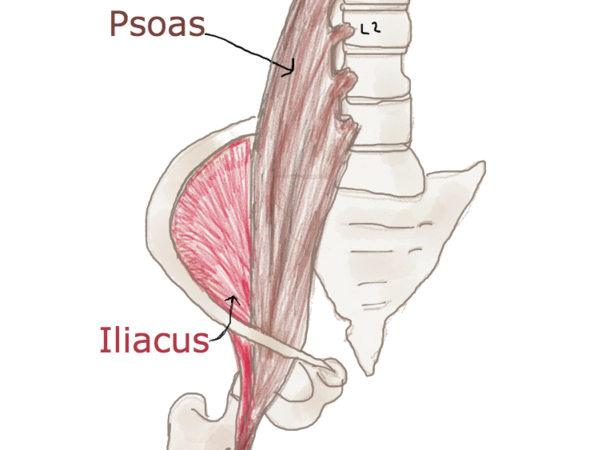
The psoas is really a vital muscle which links the upper body and the lower body. It attaches along the spine at one end, in the lumbar area, and at the inside of the thighs at the other end. It is involved in a variety of movements and actions such as balancing the core, connecting with the diaphragm or stimulating the internal organs and nerves - but it is mainly a hip flexor that draws the thigh towards the upper body.
The psoas and lifestyle
Although we might not notice it, the psoas is contracted when we sit. In other words, if we sit for long hours every day, the psoas is constantly contracted. What happens then? It tightens, shortens and pulls on the lumbar spine, sometimes even twisting it. This not only puts pressure on the discs but also on the surrounded muscles. Hence the sensation of tension and compression in the lower back!
What should we do?
Since a tight psoas is a problem, we should stretch the psoas. However, we also want to tone the psoas. Why? Because a weak psoas muscle also leads to bad posture and ultimately back problems. If the psoas is too weak, the pelvis is pushed forward and the lumbar spine flattens.
The difference between a “toned” muscle and a “contracted” muscle is crucial. Even when a muscle is at rest, there is some contraction in it. This is called “muscle tone”. It is important to have toned muscles because otherwise it takes a lot of effort to go from completely relaxed to the desire movement. To put this another way, a toned muscle responds more easily and swiftly to the command from the brain to move because there is the right amount of tension. A contracted muscle doesn’t because it has too much contraction. So we want the psoas to be toned: not contracted nor too weak.
How Yoga can help
Yoga can help by releasing, stretching and toning the psoas. For example in my online yoga class below we will start with some movements to “sense” the psoas. They are very slow subtle movements but once you sense your psoas muscle, it is easier to notice the toning or contracting actions. So repeat them a few times if needed to connect with your psoas.
Class: Stretching and releasing the psoas
with Veronique Gauthier, Yoga Therapy, All Levels, 20 mins
It is worth the effort! The benefits of releasing, stretching and toning the psoas are indeed numerous. It will of course alleviate tensions in the lower back. But because the psoas connects to the diaphragm, releasing it will also help you breathe better, feel more relaxed.
As Sandra Carson wrote in Stretching your stress out:
Enjoy this wonderful feeling!
Veronique
Practice online with Veronique in her program:


Véronique is a yoga therapist and certified advanced breathwork practitioner. She first graduated as a Vinyasa yoga teacher in 2009, and then did a 500 hour advanced training in yoga therapy five years later. Most recently, she completed a two-year advanced training in breathwork, recognised by the Global Professional Breathwork Alliance (GPBA) and the International Breathwork Foundation (IBF).