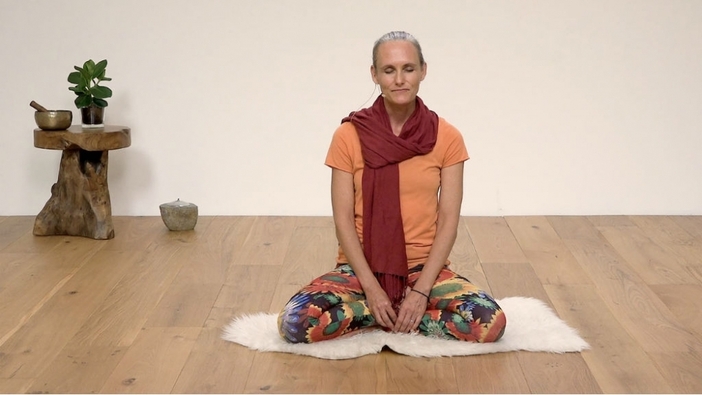
Yoga and glaucoma
Glaucoma?!?
It was as if a hot iron poker had been placed on my skin as the ophthalmologist looked me in the eyes and gave me the diagnosis.
As yoga teachers, we are trained to tell people with glaucoma to avoid headstands and most inverted poses, due to an increase in pressure in the eyes. This pressure is already elevated in people with glaucoma, and high levels of intraocular pressure (IOP) can lead to optic nerve damage and eventually blindness.
The conversation in my mind jumped to: “Inversions are not a good idea for glaucoma. So that means Headstand and Shoulderstand are out. Handstands and Forearm balances, too… that’s ok. I can deal with that.”
I asked the doctor exactly what he defined as an inverted position. His response was “anything where the head is below the heart.” My mind replied instantly with: “Ok… so downward dog. DOWNWARD DOG?!?!? No more downward dog?! Ever again?? Standing forward bends, full wheel, backward bends, fish pose, a wide variety of arm balances…. YIKES!! My whole practice will need to be transformed!”
No more downward dog?! Ever again?? Standing forward bends, full wheel, backward bends, fish pose, a wide variety of arm balances…. YIKES!! My whole practice will need to be transformed!”
“….And teaching…. The way that I share the practice will also need to change. No more doing inverted poses with the classes…. I will really need to step up the verbal descriptions and adjustments.”
My mind raced around in circles, creating scenarios and playing out hundreds of possible futures in split-second time. The ophthalmologist must have sensed my dis-ease, because he said very gently, “I am very sorry to give you this news. But change and evolution happen as they need to, and you will change and adapt, and as long as we can manage the pressure and optic nerve damage, it will all be fine.”
How I modified my practice
Of course. It is not even close to being a disastrous diagnosis. My body and mind are still very healthy. It is simply a matter of accepting the situation and adapting accordingly with grace. I went home and sat with all of this new information for about 2 weeks. I modified my own yoga practice to eliminate most inverted poses and found that I practised with a heightened sense of awareness of how each pose felt.
With greater attention to the area in and around my eyes, I could feel a subtle change in my eyes when doing more strenuous poses like Chaturanga Dandasana. This made me wonder if there are other movements that increase intraocular pressure that should be avoided or practised more carefully.
Questions started to arise like, “if so many poses are BAD for glaucoma, then what poses are GOOD and HELPFUL?” These questions inspired me to do more research. To find out more about what glaucoma actually is, and how certain yoga practices can benefit those with glaucoma, as well as what to avoid to prevent the condition from worsening.
Research into glaucoma
What follows is a result of the research I have done so far in my journey with glaucoma. Some of it is based on scientific study. Most of it is based on my own intuition and feeling my way through the development of a new way of practising yoga which is more gentle and nurturing for, not only my eyes, but for my soul.
The Research Scientific, data-based research on the effects of yoga on glaucoma is rare. I found that there has been only one study, which tested IOP and put them in 4 inverted poses: Adho Mukha Svanasana, Uttanasana, Sirsasana, and Viparita Karani.
That’s pretty much it for data-based evidence. It basically states that practising the 4 inverted positions, for a period of 2 minutes each, caused an increase in IOP in both healthy and glaucoma subjects. I cut out all inversions for about 3 months after this finding. So no:
- Adho Mukha Svanasana (Downward Dog),
- Uttanasana (Standing forward bend),
- Sirsasana (headstand),
- Salamba Sarvangasana (Shoulderstand),
- Viparita Karani (Legs up the wall),
- Urdhva Dhanurasana (Wheel pose),
- Matsyasana (Fish pose), etc.
When I went back for a check, my IOP had dropped to the high side of normal range. Did cutting out the inversions cause the IOP to lower? There is no way to really tell. There are SO many factors that play a part, and to really get an idea of what raises/lowers IOP, you would have to test the pressure several times daily for an extended time.
According to my ophthalmologist, there is no instrumentation that allows for really accurate readings besides the expensive, very large Goldman Applanation Tonometer like he has at his office. This is why there has not been more research done about the effects of many things on glaucoma.
Reducing intraocular pressure with yoga
I looked a bit deeper into what yoga practices could possibly help reduce IOP. What I found was a whole lot of conflicting information with no evidence-based data to back it up. It got really confusing reading that Bhastrika Pranayama is good for reducing IOP from one source, and that it is definitely one to be avoided in another. I found the same with Trataka and Kapalabhati Pranayama. In further research, I found unsurprisingly that stress can play a large role in the increase of IOP.
I decided to then set all this mind-based knowledge aside, and tune in to my own intuition. What I feel within myself is that it's time to really withdraw from the asanas. I have felt this for a long time, but have kept teaching asana because it seems to be ‘what people want’. My own asana practice has become sparse, as I spend most practice time just sitting in meditation, anyway.
As I listened deeper to this, I realised that the great passion for yoga that I feel comes actually from the philosophy and wisdom that the ancient texts of the Upanishads, Bhagavad Gita, and Raja Yoga Sutras have to offer, so I have embarked on deeper study of these. So I have used this ‘diagnosis’ as a catalyst, and even a deeper message from Life, to change the form yoga takes in my life completely.
The answers are within us
This whole process has revealed to me that the answers are all within us. We just need to listen. And when we don’t, then things like glaucoma come along to urge us more strongly to listen. And even then we still have the choice listen or not.
I have started really slowing down and being consciously relaxed from the inside. I am working on staying alert to where my attention is, and how much it gets carried away in mind-based stories which cause unnecessary stress. As much as possible, my attention rests in THAT which is unchanging: the loving awareness which embraces and comprises everything and makes this whole experience of living possible. And with this comes a profound peace.
As far as asana goes, I set a little rule for myself not to hold poses like Downward Dog, Standing Forward Fold, Fish, Wheel, etc. for more than 3 breaths or 30 seconds. I don’t practise Headstand, Shoulderstand, or Handstand anymore, and arm balances are rare too. These are what insights have come for me on this journey.
The ‘advice’ I would give to someone in a similar position is to take some time out to listen if there is something deeper within the situation that needs to be heard. If yes, then don’t be afraid to make necessary life changes. If no, then just be careful with your practice and adjust it in a way that feels right for you, being extra careful not to do many inversions or hold them for long periods of time (up to 30 seconds). Or just eliminate inversions completely if your diagnosis is severe.
- Try my class, 'Modifications for an inversion-free practice' - suitable if you have glaucoma or another condition where the head should not be placed lower than the heart.
Relax and de-stress
Consciously take time to relax and de-stress. Yoga Nidra is a wonderful way to do this. Slow rhythms of pranayama like Deep Yogic Breathing, Ujayii, Viloma, and Nadi Shodhana can also help. Stay alert and pay close attention to when the mind gets carried away in unnecessary stressful stories steeped in aversion, grasping, and ignorance. When this happens, stop. Breathe, and consciously relax from deep inside the mind throughout the entire body, bringing yourself, on all levels, into presence.
Rest your attention as much as possible in the loving awareness that embraces All Life. Repeating the mantra of Ram Dass’ teachings is a beautiful reminder: “I am loving awareness”. For all of us, it is important to nurture our eyes. Palming, warm compresses, and gentle eye exercises are so beneficial in maintaining good eye health, as well as just taking time to consciously relax your eyes. Our eyes are precious and often neglected in the busy-ness of everything else.
I am not saying that my ideas here are “right”. The aim of this article is to give some more information about the dance between glaucoma and yoga, and to help people in the same situation find their way in developing a practice and way of living that, at the very least, is more helpful than harmful for the condition.
My highest wish is that those reading this article will discover something profound within themselves, which has been tapping at life’s window in the hope of being noticed, and that perhaps the diagnosis of glaucoma (or any other imbalance) is a way to be strongly encouraged to stop and really listen to what that deep truth inside of us is saying.
With love,
Tracey
Seeing clearly - care for your eyes - a therapeutic practice for the eyes - 20 mins




Tracey Uber Cook is an internationally recognised yoga and meditation teacher with over two decades of experience helping adults and children maintain joy and wellbeing. She specialises in teaching pranayama/meditation, personal development, yoga philosophy, and yoga accessibility for the whole community.