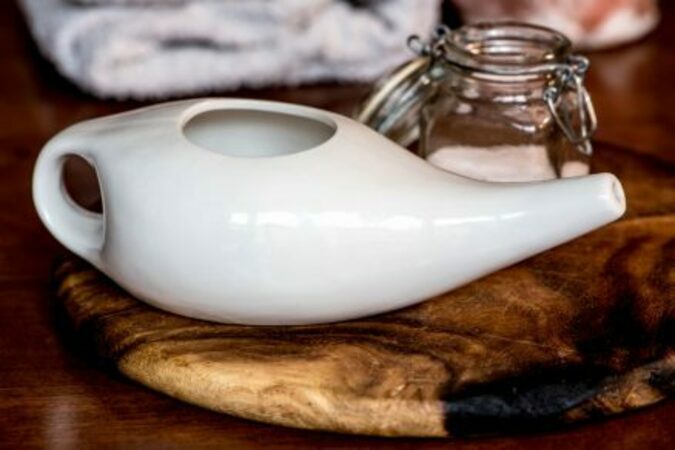
How to use a neti pot

Von Andrew Wrenn

The practice of Jal Neti, or using a Neti pot, is one of the six Shatkarmas. Shatkarmas are yogic cleansing techniques and also include KapalabhatiNauli and TratakaEssentially, Neti is a practice of cleansing the nasal passages and sinuses using a solution of warm water and salt.

On a physical level it removes obstacles and blocks in the nasal passage. Some say this helps to prevent colds as the rhinovirus in the nostril is flushed out. It is excellent to practice after a flight where we have to breathe the recycled air. On an energetic level it is said to clear the frontal lobes making you feel refreshed and energised.

Why do I regularly practise Neti?

I could give you all the different reasons and health benefits as stated in the many different yoga books or online, but these are things you can easily access and read for yourselves. Instead, I'm going to give you my own personal account of the practice and why I practise Neti regularly. 

I find we need regular reminders for our clarity, our union with the universe as it unfolds around us. We can find this in the beauty of nature, the smile of a loved one or in our yoga practice. 

Neti, for me, is a daily reminder of purity (saucha in Sanskrit). Purity in actions and purity in thoughts.

The physical action of pouring the warm saline solution through my nostrils in the morning clears the way for a new day. I find myself refreshed, my mind seems clearer. It reminds me of the feeling you get from diving into an ocean wave, and that first breath as you surface. 

Andrew

Here's how to use a Neti pot 

You'll need:

  • A Neti pot
  • Tissues
  • Warm water (use either cooled, boiled water or distilled water)
  • Natural salt such as rock salt or sea salt, avoid table salt which has anti-caking agent added (about half a teaspoon for half a litre of water)
  • Bowl or sink
  1. Add the salt to the water and make sure it has dissolved. The water should be around body temperature. 
  2. Angle the head by tipping it to one side so that the water will go up your nostril. Don't tilt your head back or you'll end up with the water going down your throat.
  3. Open your mouth a little so that you don't create an airlock. This will help the water to flow - and allow you to breathe.
  4. Put the spout of the neti pot to your nostril and pour in the water slowly - it will come out of your other nostril. You can use half or a full neti pot for each nostril.
  5. Depending on the size of your nasal passage the water may flow freely out or it may take a little longer to run through - we are all different. You may also get a delayed release of some water later so be prepared for this when you are trying neti for the first few times!
  6. After you have finished both nostrils, gently blow your nose with the tissue.
  7. You can also use some gentle Kapalabhati breathing to dry the nostrils. Exhaling through the nostrils while contracting the abdomen and letting the inhalation be passive. Do not force the breath through the nostrils too strongly here.
  8. Take a few moments to notice any changes in your body after you have finished.

Try this in class with Andrew:

Andrew Wrenn
Andrew Wrenn

Andrew is a British Wheel of Yoga-trained teacher who fuses breath-coordinated movement and classical postures to promote strength, mobility and balance.

Noureddine28.01.2015
never tried this before , I should give it a try and see.
Tina21.07.2016
After Two years of me using a net pot and feeling the benefits, my reluctant husband has been using a nasal rinse kit since polyps surgery. He is hooked. the nasal rinse appears easier as there is no head tilting but still the same: up one nostril.down the other
Andrew10.03.2019
That's great to hear, if it works for him, keep it up! Andrew
Andrew10.03.2019
That's great to hear, if it works for him, keep it up! Andrew
myr10.03.2019
also how often would you do it at first? my dad has also got chronic otitis in one year and I read that neti pots can be dangerous in case of ear infection - what do you think? finally,is there any additional suggestion or recommended sequence of practices? Thanks so much! Myriam
Andrew11.03.2019
Hi Myriam, I would consult the doctor first and foremost. If there is no ear infection then neti should be fine. As the nose and throat are connected by the Eustachian tube, there are said to be a small risk of infection, though I and the people I know who practice regularly have never had an issue, (I've been practicing neti for over 15 years. As to recommended practices, I would keep to gentle practices to begin with, always with awareness, if it doesn't feel right, it probably isn't.
Andrew11.03.2019
Hi Myriam, I would consult the doctor first and foremost. If there is no ear infection then neti should be fine. As the nose and throat are connected by the Eustachian tube, there are said to be a small risk of infection, though I and the people I know who practice regularly have never had an issue, (I've been practicing neti for over 15 years. As to recommended practices, I would keep to gentle practices to begin with, always with awareness, if it doesn't feel right, it probably isn't.
myr10.03.2019
Hi Andrew, first of all thank you so much - I only follow your videos cause I love the way you take care of people at all different stages of practice and flexibility, and how you constantly remind of the balance between mind, body and breath - it's life changing and thank you truly so much. I was fascinated by your interview in which you reveal how you managed - through yoga techniques - to get rid of all medications for your asthma, despite having reached the point where they were not being effective anymore. My father has nasal polyps. The cause for them is unknown but the only medications that give relief by reducing the size of the polyps are anti-inflammatory steroids which gives a hint that they must be related to an inflammation. He has had asthma and several allergies since birth and has been clear of smoking since only 2 or 3 years (while smoking for about 40 years, he would not perceive any allergic effect due to the anesthetic characteristic of nicotine). All he has been suggested to do now is to inhale cortison-based nasal spray. But cortison has a horrible and lengthy list of side effects. I would like him to be able to stop taking cortison/steroids like you did and not arriving at the point of needing surgery. I'm gonna try introducing him to the practice of the six Shatkarmas that you mentioned, but I wonder whether you would have any more tips to share from your won personal experience.: For instance: - how often to practice what and when to increase - how to reduce medications meanwhile (cortison brings also horrible withdrawal effects) Thank you so much Andrew for all you do - Namaste Myriam
Andrew10.03.2019
Hi Myriam I would recommend practising daily, mornings are best. I would build things up very gradually, say, try for a a month or two before going further. It took many years for myself to come off medication. If I look back, I didn't have a goal in as much as I thought I would be on meds for the rest of my so it took me completely for surprise when the asthma nurse said I didn't need any further check ups. So, maybe that would be advise, don't have a goal or look for an out come, just simply go with the practice and as much as can be, move through the practice, the day, (and his life) from a foundation of contentment so there is not the projection and angst and sense of disappointment that can arise if you are looking or waiting to be 'cured'. As to reducing medication, I would work with the doctors and possibly have more reviews so they can monitor things more closely and see he is not over medicating. I wouldn't just take things in your own hands. As an aside, in retrospect, I think spending time in warm places in the dampest part of the year also helped my breathing, (if this is possible), I found a week or two away somewhere dry and hot were beneficial to myself. wishing you both well Andrew
Andrew10.03.2019
Hi Myriam I would recommend practising daily, mornings are best. I would build things up very gradually, say, try for a a month or two before going further. It took many years for myself to come off medication. If I look back, I didn't have a goal in as much as I thought I would be on meds for the rest of my so it took me completely for surprise when the asthma nurse said I didn't need any further check ups. So, maybe that would be advise, don't have a goal or look for an out come, just simply go with the practice and as much as can be, move through the practice, the day, (and his life) from a foundation of contentment so there is not the projection and angst and sense of disappointment that can arise if you are looking or waiting to be 'cured'. As to reducing medication, I would work with the doctors and possibly have more reviews so they can monitor things more closely and see he is not over medicating. I wouldn't just take things in your own hands. As an aside, in retrospect, I think spending time in warm places in the dampest part of the year also helped my breathing, (if this is possible), I found a week or two away somewhere dry and hot were beneficial to myself. wishing you both well Andrew