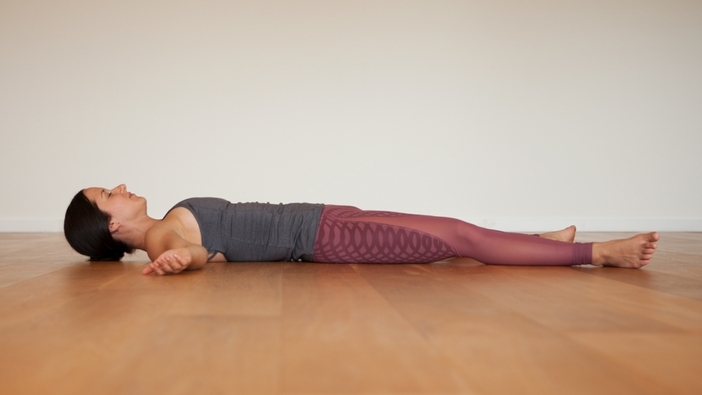
Why Savasana is so important
If you struggle with Savasana or skip it altogether, you are definitely not alone. We look at the paradoxical nature of Savasana and why it's so important to our yoga practice.
“...And now, for the final resting pose…”
When I attended my first yoga class in my early twenties, these words were a signal for me to start quietly reaching for my socks, rolling up my mat and tiptoeing out of the door. The class was very dynamic - I now think of it as ‘Yogaerobics’ - nevertheless, it was unthinkable for me to spend time 'lying around on the floor' as I viewed Savasana back then.
My practice took a turn about a year later when I found a teacher who was much more interested in the spiritual aspects of yoga than the physical, focusing more on breath awareness and the subtle energies of the body, rather than on whether students could do full Splits. But still I resisted. I practiced Savasana - or my version of it - sitting up. There was something inside me that could not, or would not, let go…
The busy body / monkey mind
Initially my own resistance felt like a physical, rather than a psychological one. The very act of lying down, open and undefended on the floor, was almost impossible for me. Even when I did lie down, I would keep my eyes wide open, body rigid, utterly defiant against physical relaxation. When I finally let my body relax, there were even more horrors awaiting me! Where does this irritation come from? Why is my left earlobe suddenly itching? How do I stop my mind from whirling? Is this supposed to be relaxing? When can I please move again….?
The paradox of Savasana
It always seemed like a great irony to me that the meaning of Savasana derives from the Sanskrit word meaning 'corpse', because as soon as I lay down on the floor, it would feel like my body, not to mention my mind, was at its most alive. Restlessness, boredom, even a sudden itch ...it seemed that my body was determined not to let me relax. It took a while before I realised that the restlessness was not physical issue, but one that originated in my mind.
The challenge of stillness
During our modern yoga classes where we are generally guided through a series of asanas, our minds are often absorbed with the more physical aspects of the practice - alignment, breathing in and out at the right time, balance ... Let's face it, there’s no time for boredom when you’re trying not to fall over in Warrior 3! However, when the body is resting on the floor, this focus is suddenly gone. The mind has nothing to ‘do’. This is where boredom, restlessness, irritation or even a sudden urge to scratch that left earlobe comes into play.
The myth of productivity
Discounting my ‘Yogaerobics’ days, I've experienced (and taught) Savasana many times. Guided relaxation, breathing awareness exercises, suggested imagery, lavender eye pillows, candlelight, soft music, aromatherapy sprays ...or just silence... They can all have their place in the guidance towards relaxation.
But true stillness comes from deep within; when we give our weight to the floor, let gravity hold us and we allow ourselves to release everything we are holding onto - physically, mentally, emotionally... Undefended, uncontracted, undiluted acceptance.
For me, though, the biggest change occurred when my approach to the idea of what constituted ‘productivity’ altered. For many of us, (and I think it’s especially true of women in the West) our ideas of self-worth are caught up with the notion of being “busy” and “useful” and if we’re not filling every moment of the day Doing Something then we’re being “unproductive”.
The shift in my attitude came about partly through meditation; when I realised that simply Being is as “productive”, if not more so, than Doing. That some of my greatest moments of clarity have been in the moments of silence and stillness of the Undoing.
Why Savasana is so important
Key benefits of taking time to rest in Savasana include:
- Release: it can help bring about a deep state of rest which can help to release stress and muscular tension
- Rejuvenate: after an energetic practice, Savasana can help ‘reset’ the body temperature, calm the central nervous system and bring the breath back to normal.
- Integrate: it gives you a chance to absorb the benefits of the practice, enabling you to knit together the body, mind and breath
...So instead of skipping Savasana because you ‘don’t have time’, remember that unlike many other yoga poses, you can take Savasana through your whole life. So give it some attention, give it some space. Become absorbed with the movement of your breath rather than your body. Know that those moments of Being may just be the best thing you do for yourself all day.
Try it in class with Paula Hines
This is an invitation to bring some physical rest into your day. In this practice Paula will show you how to set yourself up in a supported restorative Savasana before taking you through a guided relaxation. This practice can be done in bed before sleep, or use it anytime you're in need of some soothing or nurturing.

Kirsty is from the UK and moved to the Netherlands to work for EkhartYoga (now YogaEasy) in 2015. She's an E-RYT 500hr trained yoga teacher and has completed many courses in meditation, anatomy, mindfulness and Yoga Nidra. Kirsty previously worked in publishing, graphic design and recruitment. Her role as Content Lead at YogaEasy includes content writing, program creation, and teacher relations. She is currently studying for a Masters in Creative Writing for Therapeutic Purposes.