The flexibility myth

Von Sandra Carson

“I am too stiff to do yoga” must be the most common argument I hear from people who say they are interested in yoga but have never tried it. Of course, they could just be giving me a polite reason not to take a class but not practising yoga because of inflexibility may be the poorest excuse out there. Not only will yoga help improve your range of flexibility but in fact, being ‘stiff’ may prove to be an asset in your practice. 

In this article we'll look at what we really mean by stretching, the role of fascia and muscles and how we can get the benefits of yoga and movement without "overstretching" our bodies.

In the media and also among yoga classes and teachers, there is a huge emphasis on flexibility. So much so that it seems like a prerequisite to starting yoga. There are very few yoga teachers in the public eye that cannot do a full split or bend in a pretzel shape. We now seem to have created the situation where flexibility equals being a good yoga practitioner or teacher. For a long time I also believed this to be true. I have come a long way since then, and feel like maybe it is time to start countering this widely held belief. 

I have been a yoga teacher for almost 15 years. Yoga is an integral part of my life. Yoga has made me very flexible and has had a good and healthy impact on my body and soul overall. Granted, being "bendy" looks good in photos and people are impressed that I can reach beyond my toes. But whether or not that equals ‘good yoga’ is another question.

No pain, no gain

Over the years, over-stretching my body has been the cause of numerous yoga-induced injuries. I have had so many I can hardly count them: over-stretched inner thighs, hamstrings, shoulders, and so on. For over six years, my overused and overstretched psoas caused radiating pain in my torso and lower back. All those years I tried to heal myself by aligning, strengthening and practising yoga. Then it occurred to me I might be doing too much; too much yoga and way too much stretching.

Most ancient yoga teachings don't advise taking yoga to the extreme. Doug Keller, an expert in yoga therapy and yoga philosophy and history, states that Tantric yoga scriptures teach moderation. This moderation applies to every aspect of life: eating, socialising, meditating, practising asana. This wisdom does not appear to have carried over into the modern day view on mainstream yoga. We are bombarded with images of yogis in ever more extreme poses looking very radiant and peaceful. These images seem to suggest that the more you practise, the more flexible you become, the better yogi you are and the happier you will be. But if we take a closer look you may be shocked to learn this may not hold true. Let's take a look at the technicalities and effects of stretching the body.

What is ‘stretching’ anyway?

Stretching is a word that fascia expert Tom Meyers doesn’t like; technically it is not something that you are doing. In performing a yoga pose, you are exerting strain on (various parts of) your body. This strain is distributed along certain lines and pulls on the muscles, tissues and joints along a network of connective tissue. To really understand what we are doing, we need to make a distinction between putting strain on the muscles and the fascia, or connective tissue.

When coming into a stretch, the body responds first by a freeze reaction, known as the ‘stretch reflex’, in which the muscles initially protest against the strain. Depending on your condition and routine, this strain releases after about one to three minutes. Muscle is elastic by nature and when the stretch reflex subsides and the fibres of the muscle release, the muscle will go to a more lengthened state. This is the normal expansion and contraction of a muscle and therefore is not really a ‘stretch’. Once the ‘stretch’ is over, the muscle will contract again to its natural state. So nothing much has really structurally changed in the muscle.

However, it is different story with the connective tissue. After the stretch reflex releases, the fibres of connective tissue, which are less elastic, will start to ‘glide’ to a more extended, more lengthened state. In contrast to the muscles, the connective tissue fibres re-attach in this extended state. Connective tissue stretches in a way somewhat similar to how plastic stretches; if done slowly and evenly, the fibres will come into a new form or shape and keep that shape. But if done too quickly or unevenly, the plastic will tear. But to keep it simple; we will use the term ‘stretching’ to describe this process of altering the form of the body.

Types of fascia

Fascia is found everywhere in the body. It holds your skeleton together, encases your organs, nerves and muscles. It is even found in your eyes! Fascia also exchanges information to the brain through the many nerves that run through the tissue. For the yoga practitioner, three types of fascia are important to keep in mind: the ligaments, the tendons and myofascia:

  • The ligaments are connective tissue that connects your bones. This tissue is very fibrous, strong and inelastic and meant to hold bones together and stabilise the joints.
  • The tendons connect the muscles in your body to the bones or connect muscle to muscle. This fascia is less thick and fibrous, and is less inelastic, but is also not meant to stretch.
  • Myofascia runs through your muscles and encases your muscles in compartments, much like an orange having different parts. The myofascia holds the muscle bundles together.

Benefits of stretching

Stretching your body is a good thing. It is healthy for the muscles to be stretched and the myofascia to be under tension, especially when the body is well aligned. Stretching promotes circulation and therefore keeps the joints and muscles flexible and juicy and keeps the body supple and vibrant. In addition, connective tissue is responsible for your body awareness. Supple and hydrated fascia give you a sense of spaciousness and connectedness to your body as the nerves in the fascia can optimally communicate with your brain. Furthermore, the connective tissue in your body is also partly responsible for your proprioception, your body’s sense of where it is in space and how it relates to itself. The practice of yoga and stretching muscles certainly contribute to body awareness and overall good health. But you can also enjoy these benefits without being able to put your legs behind your head.

Overstretching

Sometimes in class, when I see my students struggling to grab their toes in Paschimottanasana (Seated Forward Fold), I jokingly remind them: “There is no prize; you will not get enlightened when you reach your toes". Although that usually gets a chuckle or two, students rarely back off and continue to try to pull themselves deeper into the pose, to stretch beyond where they are.

In my experience, flexible people are in general more at risk of injuring themselves than stiff people when practising yoga. Many bendy students have a tendency to bypass a core stability and integrity in their body, When stretching in a yoga pose, the strain is not isolated, but pulls on a whole system of connective tissue, which leaves them vulnerable to overstretching of the weaker parts. This can lead to nasty and sometimes chronic situations, which I have seen a few of in my years of teaching. Yoga practitioners striving for more and more flexibility increase their risk of tendon, ligament and joint overstretching, with many consequences.

The potential damage

Every time you experience “sore muscles” after yoga or exercise, you have torn muscle fibres. Micro tears in the muscles are normal with exercise and heal quickly. Muscles have good blood flow which allows regenerating cells to work efficiently and fast. These micro muscle tears are different from tendon tears, which are quite common in yoga because of overstretching. This type of tear takes a lot longer to heal (up to a year is not uncommon). Overstretching ligaments takes the damage one step further and in some cases can lead to chronically unstable joints. Too much pulling on the joints when stretching is probably the riskiest kind of overdoing it and the one that has the longest lasting effect on the body.

A common example of overstretched tendons and ligaments are hamstring attachment tears, also known as ‘yoga butt’. This is quite common and often caused by extreme forward bending or hip flexion poses, such as Uttanasana (standing forward bends) or Paschimottanasana (Seated Forward Fold) variations or asymmetrical hamstring stretches such as Utthita Hasta Padangustasana (Extended Standing Hand to Big Toe pose).

An example of ligament over-stretching is overstretching the legs in poses that put the sacroiliac (SI) joint (between the two sides of the sacrum at the back of the pelvis) or the lower back under too much pressure. The SI joint can then dislocate and cause a host of problems in both the legs and the spine, such as radiating pain in the pelvic area or sciatic nerve pain. This can be caused by extreme stretching in variations of Eka Pada Rajakapotasana (One-Legged King Pigeon pose) or Ardha Matsyendrasana (Half Seated Spinal Twist).

When less flexible fascia is a benefit

Many teachers have only limited knowledge about the potential dangers of stretching and so may encourage students to move deeper into a pose than what may be healthy for them.

Having stiff muscles, or more accurately less flexible fascia, constricts your mobility and at the same time protects your joints and ligaments from overexertion. The stability of your body protects you against injuries like the ones I described above. You may never do a full split, but you will probably never destabilize your sacroiliac joint either. So the next time you are encouraged to stretch yourself beyond your limit, stop for a moment and consider what you are trying to achieve.

Honour your yoga body

While it may seem otherwise, it is not my intention to scare you away from yoga with this article. The benefits of practising largely outweigh the risks associated with the practice. It’s not the practice of yoga that is the issue, but how we practise yoga. We can get so fixated on getting somewhere, becoming something, that we bypass ourselves and unconsciously put our health at risk.

We tend to forget that the most valuable part of our yoga practice is simply listening to our bodies. There is no such thing as ‘a yoga body’. There is just your body. And that body is perfect for yoga.

Tips to remember when stretching:

Listen: pay attention and relax. Try to feel your body before going into active stretching. Do you notice any compression in parts of your body? Are your joints open or locked? Do parts of your body feel vulnerable or sensitive? Are you holding your breath and tension in your body? The better you listen to your body, the better you learn to stretch.

Align: feel and root down through your bones and skeleton. Muscles work most optimally when the bones are well aligned in their joints. Aligning the bones will reduce unnecessary tension because you primarily rely on the stability of your skeleton rather than your muscular system. Keep all your joints open not locked; in particular, knees, wrists, elbows, shoulders and spine.

Go slowly: over-stretching is easily done when you rush into the pose. When you are in a hurry, is this because you are not fully present and attentive (see #1)? Are you bringing your stressful office day onto your mat? Or is it because the pose is maybe a bit beyond your ability and you want to do it anyway? Going slowly allows you to see your motivation more clearly and shows you where your limits are.

Boundaries: work within your limits, not right up to or over them. You have two edges - a hard edge and a soft edge. Work in the space between these two boundaries. Doing so will enable you to stretch for a longer period of time (this increases the chance of creating structural change) and keeps your body safer in the pose.

Use props: props are largely considered by yogis to be for the inexperienced practitioner or only used “when you cannot properly do yoga”. You can do yourself a big favour by dropping the arguments you may have against props. Props are your friend; they help you to feel more (like a block between the inner thighs), to support you and give stability. People come in all different sizes and dimensions - yogis too!  If you have long legs and shorter arms using two blocks in Uttanasana (Standing Forward Bend) is just using common sense.

Engage: in a dynamic, active class, always, always engage your muscles to stabilize your joints and muscles before actively stretching your body. Many injuries stem from the lack of proper engagement in the body. Activation of your muscles compresses the muscle fibers so the muscle becomes shorter, which reduces the risk of unsafe stretching.

Enjoy: how do you feel in the pose and in the stretch? Are you struggling? Are you bored? Or does the pose make you feel vibrant and alive? Enjoying and feeling pleasure in your body is the reason a yoga practice is so deliciously juicy! Safe stretching is a big part of that. When you stretch, there may be a feeling of opening part of you that has not been seen for a while, that has not moved and feels numb or stuck. Addressing these parts of your body should be a very satisfying aspect of your practice and a motivator to come back to your practice again and again.

Stretching the hips in standing poses
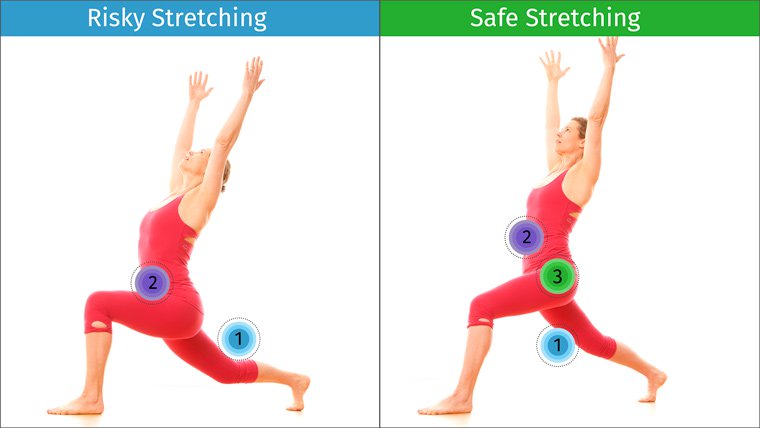
Risky and safe stretching in standing poses

Risky stretching

  1. “Hanging” in the hips by allowing the back leg to drop to the floor creates unbalanced tension in the hip flexors.
  2. This "hanging" potentially compresses the sacroiliac joint when stretching.

Safe stretching

  1. Draw the legs to the midline and lift the back leg to create a safe stretch in the hip flexors. 
  2. Engage the lower belly muscles to align the pelvis and sacrum.
  3. Now, from the center of the pelvis, stretch out through both legs and up through the spine.

Stretching in Adho Mukha Svanasana
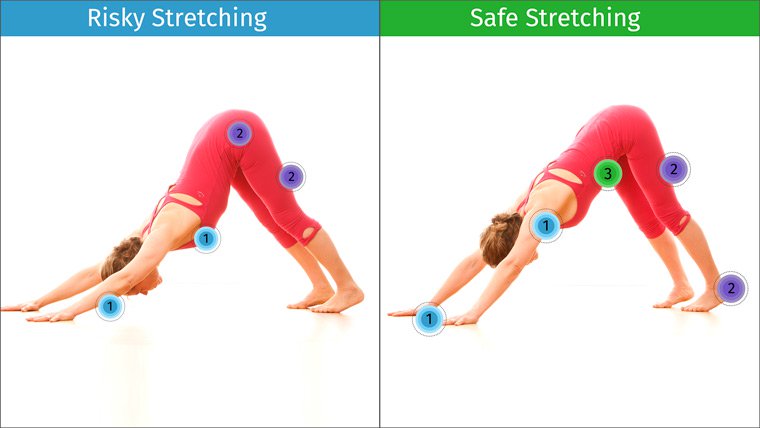
Risky and safe stretching in Downward Facing Dog Pose

Risky stretching

  1. Dropping the arms toward the floor while pressing the chest down and “hanging” in the shoulders pulls the shoulder blades off the back ribcage. This compresses the shoulder joints and can be damaging to the rotator cuff muscles.
  2. Lack of muscular engagement in the legs and excessive forward tilt of the pelvis exposes the hamstrings to overstretching.

Safe stretching

  1. Press the hands evenly into the floor to engage the arm muscles in a balanced way. From the hands draw the muscles up “into the shoulders”. 
  2. Press your feet into the floor and engage the leg muscles, pressing the tops of the thigh bones and sit bones back.
  3. Then draw the belly in and from the sternum stretch out to the hands and to the feet.

Stretching in Uttanasana
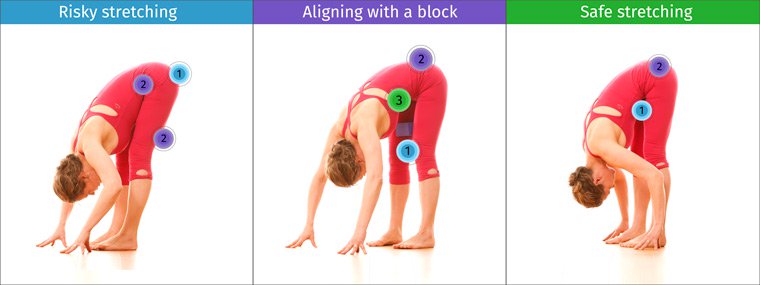
Stretching and aligning in Uttanasana

Risky stretching

  1. When the pelvis is behind the ankles it promotes “hanging” in the pelvis and hamstrings.
  2. This misalignment and lack of muscular engagement compresses the hip flexors, creates excessive pressure in the sacroiliac joint and increases the risk of overstretching in the back of the legs and pelvis.

Aligning with a block

  1. Bring the pelvis directly over your feet. Use a block to engage the inner thighs, “hug into your midline” and activate the leg muscles.
  2. Keep the knees soft and press the (inner) thighs and sit bones back until the pelvis tips forward and the sacrum is the highest point in the pose. For people with tighter hamstrings and inner thighs, bend the knees as much as needed until the forward tilt happens.
  3. Draw the lower belly in and hug the outer hips, until you feel a “lift” in the front body.

Safe stretching

  1. Keep this alignment and stability in the legs, outer hips and belly.
  2. Now press down from the centre of your pelvis to your feet and from the pelvis lengthen through your spine and crown of your head.

Stretching in Bhujangasana
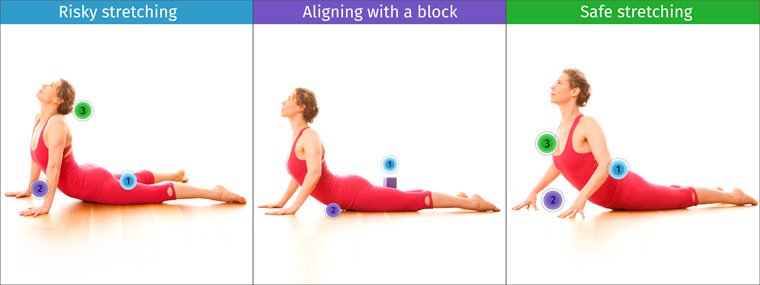
Stretching in Bhujangasana

Risky stretching

  1. Lack of muscular engagement in the inner thigh muscles, separates the legs away from the midline, compresses the sacrum and creates excessive lumbar extension (arching).
  2. Unengaged hand and arm muscles build up pressure in the wrist joints and allows the arm bones to move to the front of the body. This creates compression in the shoulder joint and upper back.
  3. Pressing the head into the neck creates compression in the neck and overstretching in the throat.

Aligning with a block

  1. Use a block between the inner thighs to help create stability in the core line of the body. Activate your inner thighs by pressing into the block and “roll” the leg bones inward. This helps to align the legs, the pelvis and the lower back.
  2. To protect and stabilize the lower back in the backbend, draw the lower belly muscles in.

Safe stretching

  1. Keep the alignment and stability in the legs. Lengthen the sides of your waistline and release your shoulders down. From your pelvis stretch out evenly through legs and spine.
  2. Press the hands (or fingertips) into the floor and activate the arm muscles from the hands into the shoulders. Draw the shoulder blades onto the back.
  3. From the engaged arms and legs and core, now move your chest forward (not straight up!) between your arms. 

Sandra Carson
Sandra Carson

Sandra is a Certified Anusara® teacher, an E-RYT 500, YACEP (Yoga Alliance), a TRE® provider and Keto coach. She teaches workshops, trainings and retreats in The Netherlands and internationally.

Anne Berit04.11.2016
Very interesting article, answers a lot of questions, even some I had not asked yet :-) Less is certainly more, some times, and I have noticed that strength, flexibility and balance of body and/or mind doesn't go away even if I (am some times forced to ...) do a bit less. One might argue that yoga is about mind over matter, but as for asanas goes, this is not a very good strategy at all.
Sandra07.11.2016
Hahaha! You got more than you asked for;) My yoga is becoming more about "being fully present and feeling into my body" than mind over matter. That doesn't imply only staying within the comfort zone, but more that I try to feel what is going on and working with sensitivity and kindness to my body. Somehow people have no problem (also in yoga) to be harsh to and controlling of their bodies, but I feel that this attitude is more damaging than rewarding...
Gillian16.11.2018
Great article, so pertinent for the often noted experience of "trying too hard" "feeling the burn", "keeping up with others" etc etc. I have changed my practice and therefore teaching style over the last couple of years for just these reasons, and it's made a huge difference for less time 'recovering' from each practice/class, being kinder to oneself and encouraging others to do likewise. It's so much NOT about the shape or the pose itself, but the experience and pro-perception of the body, therefore mind and soul. Changing your practice to a safer, gentler method of moving and holding, using accessories and 'props' - as and when you feel like doing so - is not about 'cheating', or age, either ... Thanks, Sandra
Sandra19.11.2018
That is a beautiful explanation and exactly my mission! It is through this awareness that I feel we can begin to access the deeper layers of the practice of yoga, which are to be discovered in the "felt sense" of our body and in the reflection of our own mind. Challenging ourselves can be done on many levels and is a part of the practice of yoga, but more so than the body, we will encounter the resistance in our own minds when we slow down and learn to feel!
Cathy06.11.2016
Hi Sandra, I found this to be a seriously useful article. I am a 'bendy' sort of person. But when I started out on my yoga journey, one teacher in particular warned me in every class to be very careful of over-stretching and in such a way that I actually paid attention. As a result in my 15 years of practising I have had almost no injuries - although I have to constantly remind myself to focus on this. It is not always easy to leave the 'ego' outside the door and pull back when you know you are going too far beyond your ability; so constant reminders, and information such as your article provides, are crucial to keep us safe. I see people working with sometimes excruciating injuries very often (especially in teacher training situations ironically enough) and I think we cannot stress the need for safety on the mat enough. So, many thanks for this very enlightened article. Namaste, C ॐ
Sandra07.11.2016
Hi Cathy, sounds as if you had a great teacher! I do not think yoga teachers that emphasise (over)stretching are "evil" in any way, but rather misinformed on the issue. Particularly bad that this is stimulated in teacher trainings still. The general idea in "active" yoga seems to be that the ego is "defeated" and the mind "stilled" when we push our bodies beyond our limits. Right there could be the next phase in yoga; to play the edges without acting on the urge to control the body. That would be a wonderful thing, in my opinion...
Laura07.11.2016
The pictures at the end of the article were super helpful! I wouldn't mind a full series of pictures like this for multiple yoga poses. Thank you for the information.
Sandra07.11.2016
Hi Laura, thanks for your comment and happy you like it:) Yes, I know, visuals can be very useful. Then again, the photos are indications of what I already teach in my classes. The beautiful thing is that you can learn to feel into your own body and breath to pick up these misalignments while you practice. My intention is really to give you an example but moreover to inspire you to feel what is right for you.
Catherine04.11.2016
Very good article, Sandra. It's very tempting, I suppose, to view a more extreme pose as a better one. The pose that one can do every day for a lifetime is not the one that makes a good Instagram. I don't think you can emphasize it enough: people enter into a practice such as yoga with inherent imbalances and asymmetries; you may only find out about them once you've injured yourself. We're all either working on injury or working our way back from it. :-/
Sandra07.11.2016
Thank you Catherine, and yes, I agree with you. And having been on both sides of that spectrum (working on injuries and back out of them) I feel very passionate now about safety and honouring your body!
Saeeda08.11.2016
Thank you Sandra for a very interesting and informative article. A great reminder to work with your body, not against it. I am also learning (through yoga) to view my body as my friend, and not constantly be in battle with it. I am beginning to accept my body as it is, and that truly is transformative on a number of levels. Ekhartyoga has become part of my daily life and I am beginning to see and feel/sense the world in a much more positive light. Thank you so much.
Sandra10.11.2016
Thank you so much Saeeda for that. Your yoga practice to me is inspirational and beautiful! I am very grateful to play a part in it <3
Nikola07.11.2016
What an interesting and courageous article. Thank you for sharing so many personal things here and letting us peak into your journey. I, too, was one of those who felt "not bendy enough" to start yoga. Once I overcame that I realized how much it can do for me. Having practiced on and off for seven years now, I still cannot "master" most of the advanced positions. Your article again confirms that I am on the right path nonetheless - and who knows, maybe I'll become a yoga teacher one day, teaching everyone to be true to their own body even if their teacher cannot reach her toes ;-)
Sandra10.11.2016
Maybe some of the best yoga teachers cannot touch their toes! I feel that the things that blocks us most, is between our ears rather than our hamstrings. Working on opening those blockages, while simultaneously honouring our limitations may be one of the the richest teachings of all. We live in a (yoga) world where everything is so "makeable" and where the image of perfecting asana is so highly valued, that we completely tend to bypass the core teachings of yoga. Union or connection with ourself does not imply domination (over the body or anything else) to achieve some bendy asana.
Heather11.11.2016
You absolutely should! :)
Christina08.11.2016
Thank you Sandra, these information will keep me a happy practitioner :-)
Sandra10.11.2016
So good to read that! Happy practicing!
Anne15.11.2018
Sandra, thank you so much for this important article. I've been doing yoga for years without realizing that my hyperflexible joints put me at risk of injury. I always suspected that I needed more stability rather than flexibility in my joints, especially in my hips and shoulders, but I kept pushing my body thinking that I just needed to "open up" more. I had to smile when I read the phrase "yoga butt," because I've had a sore, tight upper hamstring forever! I always attributed it to running, but now I believe that I overstretched the poor thing. I've been following your classes here for some time now, and I've always appreciated your emphasis on stability and alignment. Do you have any classes you could suggest that could help to correct "yoga butt"? :) With love and gratitude, Anne
Sandra19.11.2018
Hi Ann, I am so happy the article helps you to understand your body and take care of your hamstrings! Basically all my classes are repeating the mantra "create stability before stretching" and so you will find the cues to safe stretching in all of them! It is important in relationship to your hamstrings to activate both the hamstrings and the thigh muscles before stretching them. I will have a "hamstring repair" practice on Ekhart Yoga soon, so keep your eyes out for that! Love, Sandra
Sarah06.11.2016
Amazing article. So helpful and practical. Loved the explanations and pictures of the poses. Thank you so much!
Sandra07.11.2016
Aah thank you!! So glad you like it :)
Gael05.11.2016
So many thanks sandra, I will take care of myself! But I have noticed that for me a stable and strong core makes eveything less dangerous as I am very flexible. This article came at the right time for me, thanks for sharing gael
Sandra07.11.2016
Thank you Gael, I am truly happy this article gives you some support in your approach to your body in yoga:)
Francesca11.11.2018
Really useful article, thank you. Great explanations. Thank you for sharing!
Sandra19.11.2018
You are welcome, Francesca!
Jessica05.11.2016
Thank you - great article, love the 'do and don'ts'. Very helpful and I needed the reminder. Namaste
Sandra07.11.2016
You are welcome Jessica, happy it serves you!
Doris14.11.2016
Great article, many thanks
Sandra14.11.2016
you are welcome:)
David18.11.2018
I have been practicing yoga for about 3 years now and i have luckily (?) not injured myself yet. Most because i started practicing yoga through this website with great teachers always reminding us to be careful and aware. I always keep this idea in mind whenever i go to classes or practice on ekhart yoga. I refuse to do something if i feel it's beyond my limit, i might do an easier version instead until i feel comfortable enough. I think i easier to hurt yourself when you go to classes to practice, because you might want to show off or be as flexible/strong as the other people in the room. That is why Ekhart yoga is such a nice place ^^
Sandra19.11.2018
Thank you David for this comment! It is always nice to read that what our intention is here at EkhartYoga, is coming across to our members!
David18.11.2018
Namasté Sandra
Sandra19.11.2018
Namasté :)
Colleen10.11.2016
Thanks for this article. I particularly liked the part that mentions props and that it is perfectly acceptable to use them no matter what level you are at. The pictures with the explanations about the different alignments is perfect for demonstrating what you've been talking about. I will definitely do my yoga practice with more thought and care for my what my body can comfortably achieve!
Sandra10.11.2016
Beautiful! That is exactly why I wrote this article!
sally07.11.2016
Very helpful, thank you
Sandra10.11.2016
You're welcome :)
Sue11.12.2016
Wonderful article, informative and true to yoga practice, always good to ask why are we doing something and what is the benefit, not how good it looks.
Sandra20.12.2016
Thank you!
Julie18.11.2016
Excellent article, Sandra! The photos and explanations were especially helpful. I've been doing yoga for a year now and still can't put my heels on the floor in downward dog. This bothers me somewhat, but your article has alleviated my worry to a large extent. I'm sure I will refer to this article several more times. Thank you! :)
Sandra21.11.2016
Hi Julie, yes, you are very welcome:) Please don't feel like you are doing the pose "right" when you get your heels down to your mat... In my opinion, that is not what Downward Dog is about... Allow your spine to lengthen, your arms and shoulders to gently stretch as well as your hamstrings and calves, that would be a very yummy and healthy way to practice your Dog pose! Good luck!
Mary09.11.2016
Thank you Sandra for this very helpful article.
Sandra10.11.2016
You are welcome Mary, thank you for your comment
Marie-Anette24.01.2017
Thank you, this is a very nice and clear way to help practicing in respect to our body.
Debra15.11.2016
THANKS Sandra for this timely and thorough article complete with photos and directives!!!! I recently joined a new yoga studio. I was a little too eager and wound up with systemic inflammation and unable to sleep! It felt like someone was trying to peel the skin from my body. My chiropractor emphasized that any pain that comes when stretching is the body's way of protecting itself..."SO LISTEN TO YOUR BODY!"
Sandra21.11.2016
Oohw Debra, that sounds super painful... It's precisely this what I would like all to know and to be aware of.... Listening to your body instead of pushing beyond your limit. Hopefully with more of this insight we can all learn to keep ourselves safe! Thank you for sharing and I hope you feel better.
claire12.11.2016
Hello sandra! I am complete beginner and i ve started yoga 2 months ago I do pratice 3 to 4 times a week with ekhart yoga 2 weeks ago , I felt kind of "electricty" sensation on my lower back (this pain come when i cool off) is it cause i pushed too hard when stretching? Thank you for your help and congratz for this great article
Sandra14.11.2016
Hi Claire, welcome to Yoga! It is difficult for me to say where your electric pain in your low back comes from without seeing you. What you could check with yourself though, is it he curvature of your low back: is it more flat or more arched? I can recommend to do the Anusara Yoga for beginners so you will learn how to align your body in yoga. https://www.ekhartyoga.com/programs/anusara-yoga-for-beginners And yes, don't overdo it! Moderation is a good thing, just go at your own pace and respect your boundaries! Good luck:)
Gail07.11.2016
OH, this addresses so many questions and concerns that I've had over the past few years as a yoga instructor. You explain all this well. I'll share on my FB page! Thanks a million, Sandra!
Sandra10.11.2016
Great! Yes, please share with those who might find it interesting :)
Angela18.01.2017
This is a really useful article, thank you. As a new yoga teacher I have to continually check in to how I am demonstrating and leading these poses by example and the risky stretch photos really help. I can check out my own practice even more.
Sandra19.01.2017
Cool! Yes, especially as a teacher, we have the responsibility to safeguard our students and a lot of this comes by giving the right example. Do we want them to (lovingly) connect to their bodies or do we want them to touch their toes? As yoga teacher Doug Keller says:" We need to steer away from the paradigm of yoga as a flexibility practice and move toward yoga as a stability practice.
Szimona21.11.2016
Hi Sandra, THX for the reminder not to overstrech! I am quite flexible but being a perfectionist I always want to do everything perfectly (so e.g. do the pose as the teacher shows) and then I forget about minding my body... so thx again! I will keep in mind to enjoy the strech!
Sandra21.11.2016
Cool! There are so many more aspects to only doing the pose. Like what you are stating; you are a perfectionist, so how can you do the pose in a way that feels good in your body and seeing your own tendencies. Challenging and respecting yourself without going past your boundaries... that can be a lifelong practice that can bring up so many beautiful things....Thanks for sharing
Nathalie20.03.2019
Hi Sandra! Thank you so much for your article. I wish I read it long time ago! I strained my SI joint and have stiffness and discomfort in my lower back since June 2018. When you are flexible, it is so easy to"hang" into the pose. Instead of building strength in my hips (which is harder), I was "pushing" them outwards in the asymmetric standing poses, without realizing it. I think that sometimes the mind "tricks" the body to get into the pose in an easier (lazy) way. I was doing uttanasana the wrong way, feeling a stretch in my lower back that was actually pleasant when my SI joint was tight. It was so nice that I tried to go too deeper without even realizing it the risk. Now I reduced my yoga practice to restorative poses and my physio strength exercices (that are very similar to yoga asanas actually). I hope that my body will eventually forgive me to have let my mind taking over. Namaste.
Sandra01.04.2019
Dear Natalie, often we cross our boundaries without knowing it. This is unfortunate because it can take time before we get well again. I would like to think we learn valuable lessons about patience, acceptance and self love in this process. wish you a gentle and speedy recovery <3
Rebecca04.05.2018
All I was looking for! Thank you so much for this warnings, and great explanations. Have you written more about this? Can you recommend other articles, books that have the same point of view regarding safety, injuries, and respect of its own body? I am aware of the limits of my body but what worry me is this thin unknown parts, e.g one leg little smaller than other, hips slightly unbalanced, etc... How can I respect the body (mine and others) when I am not expert enough to see these small particularities? This things that are not a big problem if we don't try to 'correct' them. Thanks a lot for this great and needed article, and for sharing :)
Sandra07.05.2018
Hi Rebecca, thank you :) Most of my formed opinion I have gained through the years of practice, teaching and talking to students about injuries. My information about myofascia comes mainly from Thom Meyer's work &quot;Anatomy Trains&quot; but that does not specifically address over stretching in yoga. How to stay safe in yoga poses, is something I have been teaching for a long time and much of that, alignment wise, comes from the Anusara yoga method. I hope to add more content like this, theory wise, on EkhartYoga soon!
Crucita22.04.2019
Wow.Grazie infinite mi hai incoraggiato tanto
Sandra29.04.2019
You are very welcome!!