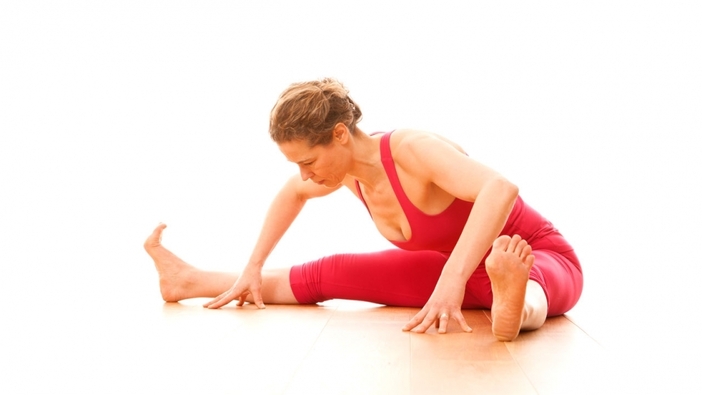
Opening the inner thighs
The adductor group
The adductor group, commonly known as the inner (upper) thighs, is a group of several muscles that, when engaged, move the legs together. They attach on the inside of your femur (thighbone) and on the other end on the pubic bone and sitbones. They consist of 5 muscles; the pectineus, the adductor longus, brevis and magnus and the gracilis muscle.
They are developed quite strongly in some people, like horseback riders but in the majority of the population, these muscles tend to be the weaker siblings to the abductors.
Yoga and the inner thighs
Hip Alignment
In the practice of yoga, these muscles become quite relevant as they initiate the alignment of the hips and low back and as such they play and important part in every group of poses, ranging from standing poses, backbends, forward bends etc. to keep the legs and hips aligned.
Stabilizes and Opens the Body
When properly used and engaged, they help stabilize as well as open the body in poses. For armbalance poses such as Bakasana, Titthibasana and so on, the adductor group needs to be activated strongly to be able to keep the legs up in the pose and stability in the core.
- Browse all
Why stretch?
The adductor muscles are unfortunately not only weak in many people, they also tend to be short! Stretching these muscles help to release not just the adductors, they also have an effect on the way we breathe by way of connecting to other muscles in a way that is very much like the wagons of a train.
Chain Reaction
The adductors attach to the pelvic floor then to the psoas and then to the diaphragm in a dynamic relationship. When one part is tight in this “train” of connection, it will have an effect and pull on the other “wagons.” In simple words; when you stretch your inner thighs, you not only make your inner thighs more flexible, you also stretch your diaphragm so you breathe better!
The adductors are stretched in poses such as Trikonasana (front leg) Vrksasana (lifted leg in Tree pose), Upavista Konasana and other poses like these.
So, every time you stretch your inner thighs, you “make a yoga,” a connection with your breath!
Try it in this free class from Sandra Carson




Sandra is a Certified Anusara® teacher, an E-RYT 500, YACEP (Yoga Alliance), a TRE® provider and Keto coach. She teaches workshops, trainings and retreats in The Netherlands and internationally.