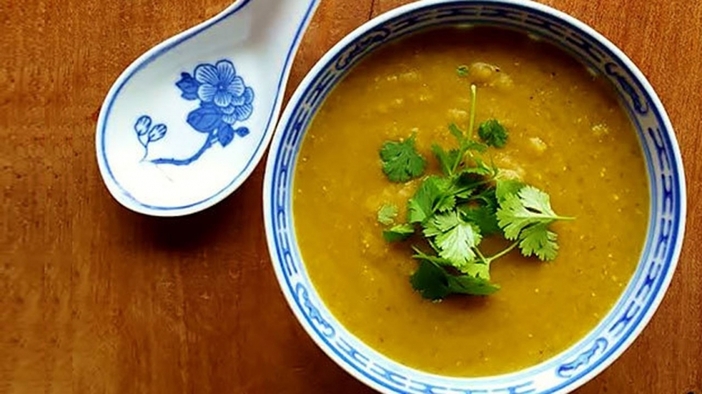
Healing miso dahl

Von Irina Verwer

"It smells like chicken soup!" my husband exclaimed when he walked into the kitchen. I’m not sure if it does; it’s been a long, long time since I’ve smelled chicken soup. What I am sure of though, is that this dahl tastes amazing. Plus, it has more healing ingredients than most chicken soups!

This nourishing and warming dahl contains inflammatory and immune system boosting spices, such as turmeric and ginger, is easily digestible because of the kombu and apple cider vinegar and gets an extra healing-kick from the miso paste and umeboshi paste – which is a natural antibiotic.

If you’re short on time, you don’t have to soak the lentils. Soaking will make them more easily digestible though, so I do recommend it here. I've given approximate amount for the spices depending on your taste.

Healing miso dahl

Ingredients

  • 4 cups yellow lentils
  • 3 stalks of kombu
  • splash of apple cider vinegar
  • 2 – 5 tsp turmeric (fresh or powdered)
  • 2 – 5 tsp ginger (fresh or powdered)
  • 1 – 5 tsp ground black pepper
  • 1 – 3 tsp cardamom powder
  • 1 – 3 tsp cumin powder
  • 1 – 3 tsp coriander powder
  • 1 – 2 tsp cinnamon powder
  • 2 – 4 tbs miso paste (I used Genmai Miso)
  • 1 tbs umeboshi paste

Method

Wash the lentils. Soak the lentils overnight, together with the kombu and a big splash of apple cider vinegar in plenty of water.
The next day, rinse the lentils and kombu.
Put in a large pan, add enough water to cover all lentils and kombu stalks (add more water if you’d like your dahl to be more soup-like).
Bring to a boil and let cook until the lentils and kombu stalks are tender. 
Add the spices in the amount you like - taste as you go!
Remove the pan from the heat.
Add the miso paste and umeboshi paste.
Use a hand-blender (immerson blender) to blend until smooth.

Serve and enjoy!

This recipe is taken from Irina's cookbook 'With a pinch of yoga', which explains Ayurveda and chakras in terms that you can understand, and then teaches you how to incorporate them into your yogic diet. All forty-six recipes are completely plant-based, gluten free, sugar-free and even sugar substitute-free. Nestled within these yummy recipes is also plenty of inspiration for your daily yoga practice. 

Irina Verwer
Irina Verwer

Irina Verwer is a yoga teacher, Somatic therapist, intimacy coach, and Ayurvedic practitioner. Her  focus is on understanding how past abuse and trauma affect our present, addressing medical challenges, exercising boundaries in life and work, and supporting people as they build stronger, more intimate connections.

Anne Berit10.02.2015
Hi, Irina. Im cooking right now, mixing the spices and I realize I'm not sure how to interpret tsp. Is that short for table spoon or tea spoon?
Anne Berit10.02.2015
Tanks Irina. I just mixed spices in a container, adding to taste and saving the rest for later. Thinking about it, tbs and tps makes perfect sense. Enjoying the soup no, admittedly without all the "funny" stuff, but still tasty. I need some new options for dinner as I have a growing dislike for meat, for some reason. Dahl is good, high in protein :-)
Anne Berit10.02.2015
Tanks Irina. I just mixed spices in a container, adding to taste and saving the rest for later. Thinking about it, tbs and tps makes perfect sense. Enjoying the soup no, admittedly without all the "funny" stuff, but still tasty. I need some new options for dinner as I have a growing dislike for meat, for some reason. Dahl is good, high in protein :-)
Irina10.02.2015
Hi Anne, Hope this finds you in time: a tsp is a teaspoon, tbs is tablespoon. Enjoy!
Irina10.02.2015
Hi Anne, Hope this finds you in time: a tsp is a teaspoon, tbs is tablespoon. Enjoy!
Sara09.02.2015
I had the same questions as Tekela. Thanks for the suggestions on how to make this without those ingredients. I'll give it a try!
Tekela09.02.2015
Irina, I am a great fan of your recipes, and this looks like no exception. As I'm struggling to fight off a bout of flu and not able to go to a wholefood shop, I'll try to make it with the ingredients available in my store cupboard. I am not sure about Kombu, is it a seaweed? Where do you get it (I live by the sea shore....but there are so many different types of seaweed) and umeboshi paste? Thanks x
Irina09.02.2015
Hi Tekela, Thanks for your comment! Indeed, kombu is a seaweed. It helps to make the lentils easier digestable. If you don't have it on hand, just soak the lentils in water with some apple cider vinegar and skip the kombu. Umeboshi paste is a salty paste made of plums. It's a natural antibiotic. If you don't have it and are not able to find it, add more miso instead. Both kombu and umeboshi paste can be bought online and in natural health food stores. May you feel well soon! Love - Irina
Irina09.02.2015
Hi Tekela, Thanks for your comment! Indeed, kombu is a seaweed. It helps to make the lentils easier digestable. If you don't have it on hand, just soak the lentils in water with some apple cider vinegar and skip the kombu. Umeboshi paste is a salty paste made of plums. It's a natural antibiotic. If you don't have it and are not able to find it, add more miso instead. Both kombu and umeboshi paste can be bought online and in natural health food stores. May you feel well soon! Love - Irina