For the love of the shoulder
These days practitioners of yoga are having so much fun playing with new variations of the tried and true ancient yoga postures. So many of us have learned the rules from the 'old masters' and have eagerly gone about to see how much and how far we can stretch, bend and eventually break those rules. Dancing through flows with many Chaturanga Dandasanas and Chaturanga variations, weaving arm balances and inversions wherever and whenever possible. Finding more and more fun, fantastic and intricate shapes to wind and bind our bodies into has become the norm in modern yoga classes and practices. But with all these good times on the mat a price is being paid. Yogic injuries are on the rise...especially injuries of the shoulder girdle.
Why so many shoulder injuries?
In order to begin answering this question we need to start with an overview of the basics:
Human anatomy 101 - bones, muscles, tendons and ligaments
There are two parts of the skeletal system: axial and appendicular.
The axial skeleton is your mainframe, your center, your core and is made up of four parts: skull, spine (31-34 weight bearing bones), sternum and 12 pairs of ribs.
Attached to this axis are the shoulder and hip/pelvic girdles and their extremities - the appendicular skeleton. These two girdles, one super stable and the other tremendously mobile, are where the levers of the body attach to the axis; where the limbs that move us, feed us and hug others plug into our mainframe.
Stable hips, mobile shoulders
Take a moment to visualize this: the hip girdle is a stable joint made of just two bones. The femur/thighbone, the longest bone in the human body, fits oh-so-perfectly into the acetabulum/socket of the illium (the big flat bone people often think of as hip and/or pelvis). These two bones were made for one another. This ball and socket joint allows for 6 movements of the femur: flexion, extension, adduction, abduction, internal and external rotation. It is supported by thick, strong, wide bands of connective tissue. The muscles and tendons here are wide and strong (gluteus maximus and gluteus medius for example) and the ligaments that connect the bones are also thick, wide and strong. This lower center of gravity joint was built exactly as it was intended: to be a foundation to support the precious cargo above it, the spine and vital organs.
Now, moving upward to the shoulder girdle. Even energetically, the thought of moving upward in the body encourages a lighter sense of being. The shoulder girdle represents this energetic notion on the physiological level by being a joint of mobility vs. one of stability. This glenohumeral joint is a shallow joint made up of three bones. The humerus/upper arm bone is loosely plugged into a "socket" that is configured by the clavicle/collarbone and the scapula/shoulder blade.
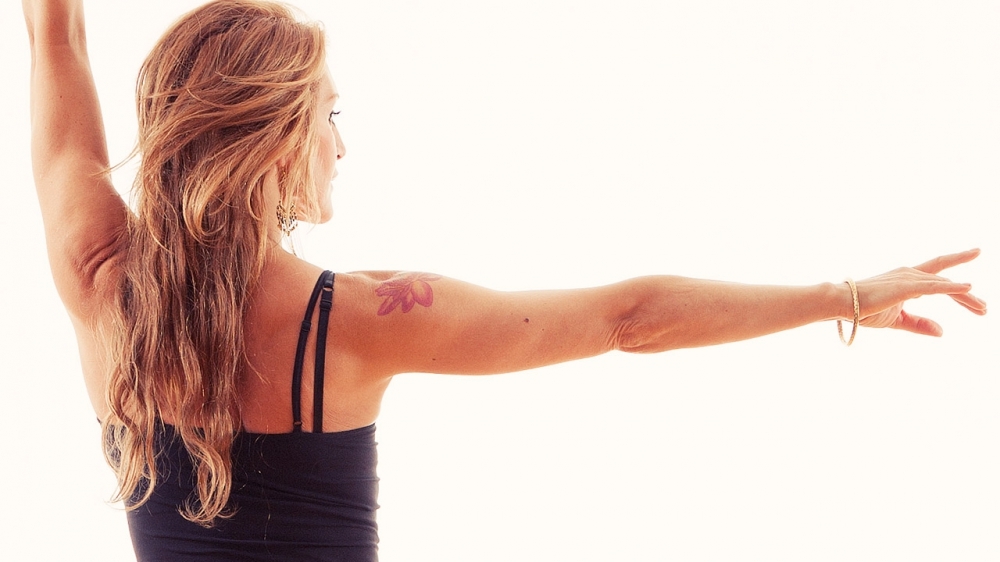
Already you are receiving a direct transmission of embodied knowledge - this joint is quite different than the hip joint. Instead of a stable joint made of two bones, the shoulder is a spacious, shallow joint made up of three. And whereas in the hip the connective tissue (especially the ligaments) are thick, wide and strong, here in the shoulder we are introduced to thin and strappy ligaments - yet still strong!
If you haven't already gotten an appreciation for the difference between the shoulder and the hip girdle, and if you haven't already begun to get a sense of why common repetitive motion or traumatic injuries tend to happen more in the shoulder (the spacious and shallow joint supported by thin, strappy ligaments), then this next fact will surely increase your knowledge, awareness and appreciation:
The three bones of the shoulder girdle and the extremities beyond the humerus: radius/thumb side lower arm bone, ulna/pinky side lower arm bone, carpals/wrist bones, metacarpals/hand bones and phalanges/the mini long bones of the fingers - are all connected to the mainframe by one tiny joint: the sternoclavicular joint.
Let me reiterate and drive this point home a little bit more: the 32 bones that extend outward from your chest and often offer an expression of what is happening in your heart only attach to your axial skeleton with one small joint. The only way all those 32 bones stay on the torso is with soft connective tissues; a systematic placement of various muscles, tendons and ligaments. It is a marvelous wonder to behold - a whole lifetime with our arms staying attached to our bodies!
The cause of injury
Due to the lack of stability in the shoulder girdle, it is easy and common to overwork and overload the connective tissues that are trying so hard to keep everything intact, especially when improper alignment is taught and practiced. In some forms of yoga we are seeing the over-stretching of ligaments which then increase the instability of the shoulder. Remember - ligaments are NOT elastic! In other systems of yoga we are witnessing repetitive motion injuries (too many Chaturanga Dandasanas) as well as traumatic injuries, for example, jumping back to Plank with straight arms vs floating back to Chaturanga Dandasana with bent elbows and upper arms parallel to floor. These are keeping too many yoga students off their mats, sometimes to the point of no return.
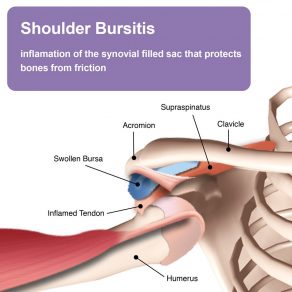
Tendonitis (inflammation of the muscle attachment to bone), bursitis (inflammation of the fluid-filled sacs that protect joints against friction) and overtime, arthritis (inflammation in the joint), are the heartbreaking yoga-related injury reports.
The question most people ask when faced with the growing numbers of yoga-related injuries, "Isn't the practice of yoga supposed to support overall health and longevity of both body and mind, not injure, maim or permanently alter in such negative ways?"
What can be done on the mat to prevent shoulder injuries?
The perfection of the human body is such that we are not simply a bunch of bones walking around (only on All Hallows Eve do we see such a sight!) but an intricate system of layers upon layers of connective tissue all glued/woven together by myofascia. The ligaments will hold the bones in place and offer structure and stability as we reach and pull, give and take, swing and swim. The actual moving of the bones are the job of the skeletal muscles. The tendons offer support to the muscles in whatever myriad of ways the bones move - in the shoulder we experience flexion, extension, abduction, adduction, internal and external rotation. Great news for us - muscles can be strengthened as well as stretched. Modern yoga is a true testament to this; the myth that yoga is only for the flexible has been busted!
Vinyasa Yoga is a perfect example of a yoga system that promotes both strength and suppleness. The three poses practiced the most in Vinyasa Flow Yoga are
- Chaturanga Dandasana / Four-limbed Staff Pose
- Urdhva Mukha Svanasana/Upward Facing Dog and
- Adho Mukha Svanasana/Downward Facing Dog.
The beauty of these three poses, especially when linked by breath in a bit of a dance, is that they strengthen, stretch and stabilize all the major muscles in the body and are great for building both stability and flexibility in the shoulder. While Chaturanga Dandasana is a whole body strengthener, Downward Facing Dog strengthens the whole front body while stretching the back body and Upward Facing Dog strengthens the whole back supporting the opening of the entire front.
Where the shoulder is concerned:
- Downward Facing Dog strengthens the flexors/anterior deltoids and the external rotators/infraspinatus) of the humerus bone, strengthens the elevators of the scapula/upper trapezius and levator scapula, stretches the adductors/latissimus dorsi, extensors/rear deltoids, and internal rotators/subscapularis of the humerus, and stretches the retractors of the shoulder blades/rhomboids and mid-trapezius.
- Upward Facing Dog strengthens the extensors/posterior deltoids, external rotators/infraspinatus and the adductors/latissimus dorsi of the humerus and the depressors/lower trapezius and the retractors of the scapulae/rhomboids and mid-trapezius and stretches the pectorals/chest muscles attached to the scapula and sternum, flexors/anterior deltoids, protractors of the scapula/serratus anterior.
All three poses strengthen and stretch the three parts of the trapezius. The only muscles not strengthened are the medial/lateral deltoids and Side Planks intelligently woven into a practice can take care of that!
Safe alignment in Chaturanga Dandasana
It is very important to practice proper alignment in all yoga poses. In Vinyasa Flow Yoga it is especially important in Chaturanga Dandasana. This pose is practiced anywhere from 1-50 plus times in any given class! It is the improper bone alignment and muscle activation in this pose that lead most people to the doctor or physical therapist complaining of pain. From High Plank, a yogi needs to shift forward with toe strength so that when lowering to hover the entire body parallel to the floor the elbows can be as close to a 90 degree angle as possible (depending on the proportion of the arm bones), the upper arms stay parallel to the floor and the ribs do not dip below the upper arm bones.
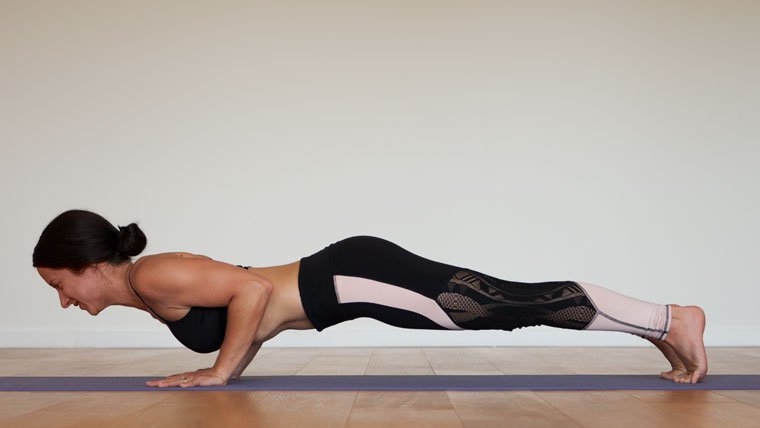
The injuries we are seeing are occurring when shoulders and ribs dip below the elbows causing tremendous strain on the shoulder girdle and elbow. And if yogis are jumping back to either High Plank with straight arms (jarring the humerus into the acromion process of the scapula and causing strain to muscles, tendons, ligaments and bursas) or landing in an improperly aligned Chaturanga Dandasana then sometimes irreversible damage to the shoulder can occur.
So in short...
Learning proper alignment and muscle activation can go along way to ensure the longevity of not only our yoga practices on the mat but of our ability to dance, play, love and even wrestle off the mat as well! Becoming keenly aware of the natural strengths and weaknesses of our girdles and the extremities that plug into them will enable us to accurately assess what muscles need to be strengthened and stretched in order to support our bodies in each and every pose. Furthering our education, deepening our awareness and putting into practice theories learned will go along way to ensure the longevity of our joints! Heart hugging others is such a great way to take our yoga off the mat into the world - to do this efficiently and effectively we need healthy shoulder girdles!
Viva La Shoulder!
Related articles:



Jennilee Toner is student and teacher of yoga and human anatomy and the author of The Perfect Chaturanga. She has been practicing Hatha and Vinyasa yoga since 1996, teaching Hatha and Vinyasa yoga since 2003 and teaching experiential anatomy to yoga teachers in training internationally since 2010. She has also been teaching her own Hot Warrior Yoga 200-hour teacher training courses since 2012 and Inner Sanctum Yoga 300-hour teacher Trainings since 2016. Jennilee has been a college professor of Anatomy and Physiology in Upstate New York since 2021.