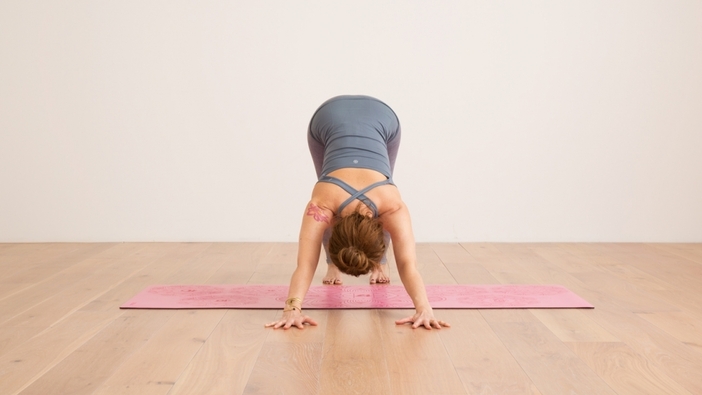
Arm rotation in Downward Facing Dog

Von Jenny Savage

Downward Facing Dog (Adho Mukha Svanasana) is one of the first yoga poses many people will learn. It's brilliant for building strength and mobility in the whole body and is neutralising for the spine in between strong twists, forward bends or backbends.

Once you get the hang of Downward Dog it can be a wonderful resting pose. However, in Downward Facing Dog it’s quite common for people to roll the shoulders and upper arms inwards. This can scrunch up the shoulders and neck, creating tension and making the pose much harder to hold.

There are two opposite actions that need to happen in the arms in order to make it both comfortable and stable. You might have heard your teacher instructing you to 'externally rotate your upper arms and internally rotate your lower arms' but this can be confusing enough even when you're not hanging upside down!

So Marlene Henny shares this easy way to learn how to position your arms and shoulders - while you're still upright. This will make your Downward Dog easier and more comfortable to hold.

4 steps to a more comfortable Downward Dog

Step One

Sit on your heels with your open arms straight out to the sides, palms facing down.
Turn your palms upwards to roll the upper arms and shoulder heads back (so your thumb will be pointing behind you). 
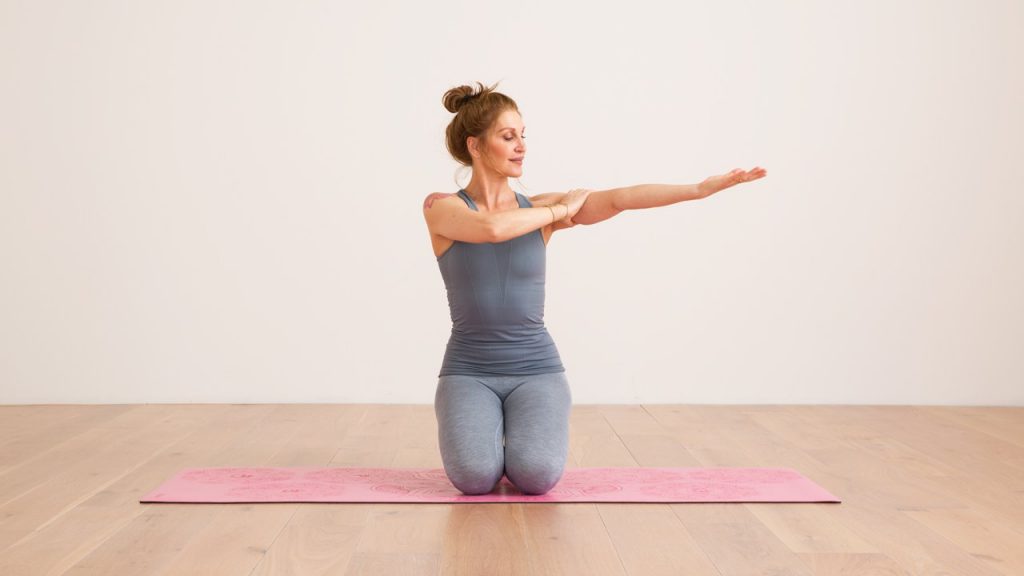
External rotation
Turn your palm upwards

Allow the shoulder blades to draw down the back keeping the base of the neck free and relaxed. You might start to feel more space and ease in your neck and shoulders already.

Step Two

Then, keeping the upper arms and shoulder blades where they are (rolled back/externally rotated), turn your wrists so that the palms of your hands are now facing the ground.

Step Three

Keep this alignment and rotation and bring your arms to the front.  Keep the arm bones plugged back into their sockets to create a strong frame with your shoulders.
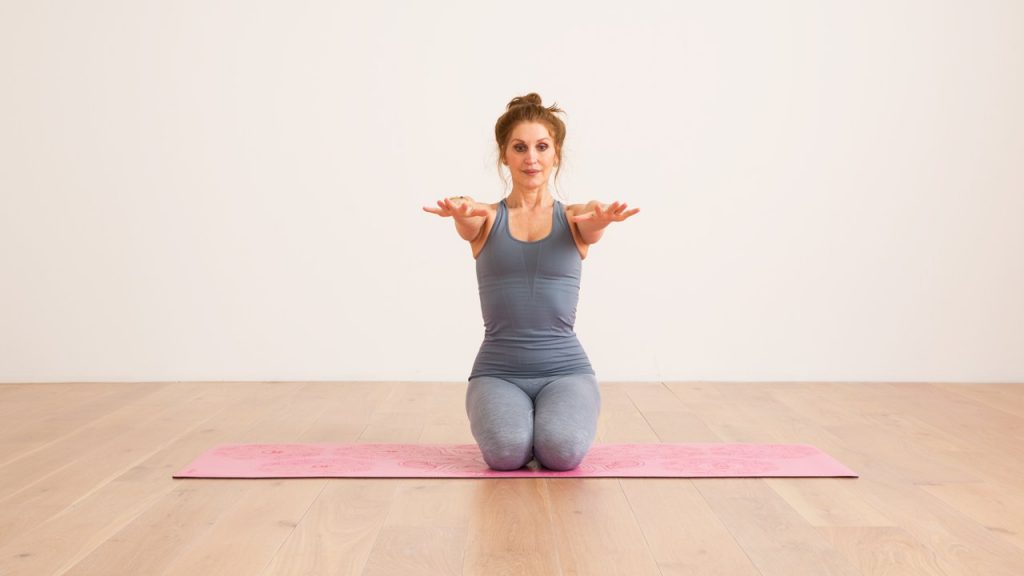
Marlene Henny showing arm position for Downward Dog while kneeling up
Bring your arms to the front

Step Four

Place the hands on the floor in front of you with your fingers spread. Think about creating a suction cup in the middle of your palm by pressing through the outer edges of the palm, the base of the fingers and the fingertips. When you tuck your toes and extend your legs into the pose, your upper arms stay rotating outwards instead of in and your shoulders will feel broad. This takes out the tension and you will feel way more relaxed and spacious in the shoulders. 
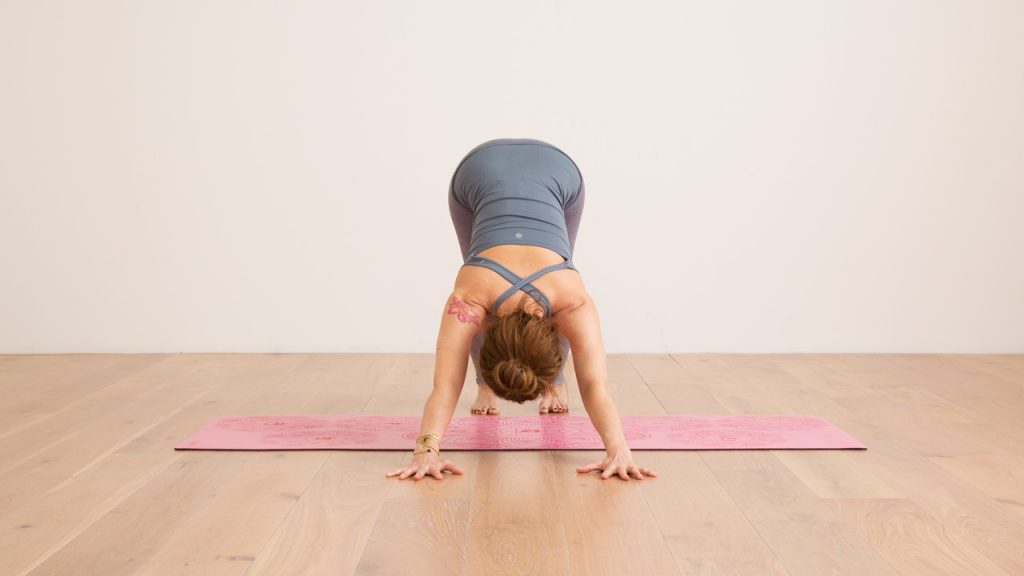
Marlene Henny showing Downward dog arms from the front
The upper arms stay externally rotated

If you feel tightness in your shoulders you can bring your shoulders a little bit forward instead of bringing shoulders back towards the thighs. Keep the shoulder blades on the back and stay here in the pose. Let your neck be in line with the spine allowing the energy to flow freely.

Remember you can always keep your knees a little bent in Downward Dog - this allows your spine to lengthen and can be more comfortable for your lower back and hamstrings. 

Watch Marlene’s class for more tips and instructions

Updated 2023

Jenny Savage
Jenny Savage

Jenny Savage was part of the behind the scenes EkhartYoga team. She first started yoga at the age of 15 and took her 200hr teacher training with Esther Ekhart in 2013. She has a background in Health Psychology, community mental health work, and health and wellbeing research.

Esther08.10.2014
Hi Esther, You turn the inside of your elbows forward, that rotates the outer arms out, while really pressing through index and thumb mount to not overdo it. Hope that makes sense.
Esther07.03.2014
Hi Sandra, You can actually do both, pressing firmly through the base of the index finger and thumb to assure the slight inward rotation of the fore arm and also pressing the fingertips down to encourage hasta bandha and to make sure the pressure on the wrist doesn't get too intense. See if you can find a balance between both that works for your specific arm/hand situation..
Sandra21.02.2014
Thank you Marlene. I have a question: I feel (not painful) my lower arms on the thumb side. In another instruction someone said to me to mostly use the fingers...pushing them in the ground and relaxing the thumb...so now I am wondering what is best. Warm wishes, Sandra
Alice12.06.2018
Splended tips. Thanks a lot! :)
Christine W19.02.2014
I am going to practice preparing for downward dog using your technique! Thank you so much!
Laurie20.02.2014
These instructions are wonderful - tks for ensuring we can fully enjoy this lovely pose!
Esther12.09.2014
I have a bad shoulder, so I'm very happy with this explanation. But I'm not sure I understand correctly. To keep my shoulders broad, it feels most natural to point my elbows a bit outward. But that makes the inside of my upper arms rotate down and then out, in the opposite direction to what the arrows in the picture say. Am I missing something?
David07.04.2016
Thank you :)
Danielle01.07.2018
Apologies for bringing this up here but I don’t see a feedback option for the app performance: there is a persistent jitter in the streaming where is goes back a second or two, every second or two and repeats. I find it distracts from the imparted information. Otherwise, your guidance on how to move into proper shoulder alignment is most helpful.
Elisa15.06.2018
Thank you Marlene. This was so helpful. I am so self conscious when I am in class and in downward facing dog because I hyperextend my elbows and roll inward. Even though the teachers instructions would be to roll the upper arms out, it was never communicated to have the lower arms roll in. The que was to have "the eyes of the elbows look at each other" which was more confusing. I'm totally clear now. And comfortable! Thank you.
Frances11.06.2018
Thank you, Little adjustments make such a difference.
Mary12.06.2018
Thank you Marlene for these helpful tips.
Beatrice25.04.2016
Hi, I joined recently and I find that your beginner's lessons are wonderfully explained. However, since they are (obviously) slow it gets hard to keep poses for so long. For example, I followed Ester's Hatha yoga for beginners lesson two (downward facing dog and plank poses), but the following day I woke up with a terrible contraction between my shoulder blades which took a few days of medication to go away. I suppose that my mistake is that I am holding poses for the whole time during the explanations, as the teacher does. However, do you think there is something else I should have done differently? Can it also be that I am overdoing your directions to push back the shoulderblades to preserve neck and shoulders? Thank you!
Beatrice26.04.2016
Thank you Esther. Re-thinking about it, my injury I think can also be related to some workout I had at the gym in the same period. Yet, after these yoga lessons I did feel some 'strain'. So I think that I've probably asked too much to my body. Anyhow, actually, my shoulderblades are quite a bit winged, so I guess that you have a very good point. And I tend to put a lot of tension in that area. I will pay attention to your suggestions. Thank you again! PS. On a personal note, I'd like to mention that I lived and worked in Amsterdam for nearly six years. That was the best period of my life, and I am deeply in love with Amsterdam and NL.
Esther26.04.2016
Hi Beatrice, You gently push up the space between the shoulder blades in plank. In down dog you gently bring the shoulders down away from the ears, but some people have too much movement there, maybe you pulled them down too much, go for the middle of up and down and see if that works better.
Marie-Anette13.06.2018
very interesting details, thankyou very much
Georgia14.06.2018
Thank you, Marlene. The first method you showed, that of bending the elbows while on all-fours works like a miracle! I can truly feel the outward rotation and can maintain it moving into downward facing dog. I think having the feedback of the ground pushing back against the hands helps to more easily maintain the shoulder rotation as opposed to the second method where the arms are in the air. Brilliant, thank you again!
Kimberly19.06.2018
Very clear and helpful!
Sheri16.06.2018
Very helpful--thank you Marlene!
Beatrice13.06.2018
This guide was wery helpful, I didn't realised that the shoulder position could affect so much the pose. Thank you!
Chantmor15.06.2018
REALLY helpful Marlene. It used to take a lot of wriggling to get this shoulder position before I saw and heard the technical details from you. Now it is simple and I can save my energy for the pose! Thank you.
Chiara15.06.2018
really helpful thank you!
Canne24.06.2018
thank you, this really helped. I can tell the difference between "elbows in" and "elbows out"...
tara15.04.2021
Lovely article, thank you. I cannot get the video to play though and would love to see the visual demonstration.
tara15.04.2021
thank you so much for sorting so quickly ! x
Kirsty15.04.2021
Hi Tara, sorry about that - the video link should be working again now 🙏🏼