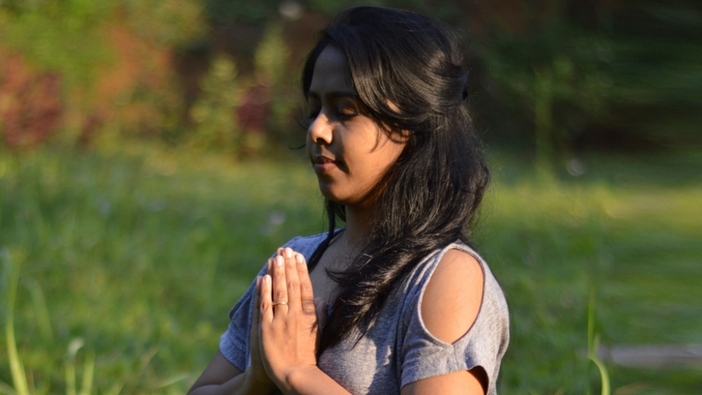
Applying yoga philosophy to asana practice and beyond
At some point in our lives we have all faced a challenging situation, either professional or personal. Each of us react differently to those situations – some learn to let the moment pass, others analyse, ask questions, and look for solutions. We may even allow these situations to fill us with negative thoughts that can affect us at a physical and mental level.
Listen to the pose
The beauty of a yoga practice is that it’s an opportunity to train our minds to react to situations or people without judgement and attachment to the outcomes. Imagine you are in a challenging pose. For someone with tight hamstrings and a stiff lower back this could be Pyramid pose (Parsvottonasana). If you struggle with balancing postures, Half Moon or Ardha Chandrasana could push you out of your comfort zone. Whatever the pose, it is communicating with you, your body, mind, and breath. Listen to it. What are you experiencing in the present moment? What can you take away and learn about your self – how do you react to certain postures? Are you looking for perfection or are you looking for that balance between Sthiram (stability) and Sukham (comfort)?
Use your breath as a guide
Allow the pose to challenge you, push you, but never allow it to wreak havoc on your breath and, more importantly, your mind. Use your breath as guide to understand when you need to stop and take a step back. Go back to a simpler version of the pose, for example, in Pyramid pose you could bend your front knee or place your hand on blocks placed on either side of your feet. If you transitioned to Half Moon from Triangle pose or Trikonasana, maybe you need to go back to the starting point and reset. Close your eyes and allow your breath to settle down before you move back into the posture. We can do this in our daily lives too. Stop, take a step back, and reset before moving ahead.
Have faith in the practice
As a yoga teacher, I am reminded every day that I am a student first. I still work hard on my core and shoulder strength to get into postures such as Crow pose (Bakasana) and Handstand. I may achieve this two weeks from now or two years from now. It is important to have a goal, but just as important - if not more - is the practice (or ‘Abhyasa’) itself.
The yoga philosophy of Patanjali’s Yoga Sutras talk about three important elements that must support this practice, and while he speaks about these in the context of achieving ‘Samadhi’ (broadly interpreted as 'bliss' or 'enlightenment'), they can be applied to any situation. These include Sraddha (faith), Virya (indomitable energy or will), and Smrti (high knowledge or intellect).
It’s important to have faith in our daily practice, our teachers, and ourselves. Energy and the will to practise will allow us to pick ourselves up when we fall and to practise with a positive attitude. Smrti helps us to learn from past experiences and apply them to the present moment, so we can take the right steps to move forward. When I fall flat on my face while practicing Bakasana or Crow pose, I know that it’s ok to get up and try again, with respect for my body and mind. I don’t beat up myself up to attain perfection. Every moment on and off the mat is an opportunity for all of us to apply these three principles of Shraddha, Virya, and Smrti.
Applying yoga philosophy off the mat
At the end of the day, yoga is not just a physical practice and asana is just one of the eight limbs of yoga. The rest of yoga philosophy talks about taking control of our mind and directing it towards a higher goal and purpose. By reflecting on our attitudes towards situations, people, the external environment, and even ourselves, we can cultivate a healthier and tranquil mind, also known as ‘Cittaprasadanam’. Such a mind will allow us to perceive and react with clarity. So the next time you move into a challenging posture or face an uphill battle, remember to come back to your breath. When you do this, the mind will follow you where you need to go.
Learn about yoga philosophy online
If you're interested in yoga philosophy and want to learn more about it, take a look at Anat Geiger's online course, The Fundamentals of Yoga Philosophy on the YogaEasy Academy.
Further reading:
If you enjoyed this article and want to learn more, read:
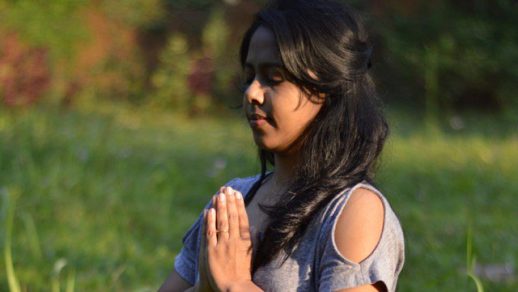
About the author: Roopa Palanivel is a Vinyasa Yoga teacher from Chennai, India. A long time yoga practitioner, she left her full-time marketing job at an IT company to complete her Yoga Teacher Training (YTT) from Krishnamacharya Yoga Mandiram.
She also received advanced teacher training from Srivatsa Ramaswami, who was long-time student of Krishnamacharya himself. While her training is strongly rooted in ‘Vinyasa Krama’, she uses insights gained from her own yoga practice over the last 14 years to create a unique experience for her students.


Written by one of the YogaEasy (or previously, EkhartYoga) staff or guest writers. A team of yoga teachers, yoga students, anatomy geeks, and recipe creators.